

Best Logic Puzzle Games of All Time (Free)
The best logic puzzles ever invented, from Sudoku and Nonograms to Star Battle, Takuzu, Shikaku and Slitherlink, what makes each one great and where to play free.
A great logic puzzle has three things: rules you can learn in a minute, a single solution you can reach without guessing, and a moment when the whole grid suddenly makes sense. Puzzle designers, many of them working for the Japanese publisher Nikoli, have refined dozens of formats over the last few decades. Here are the best logic puzzles of all time, what makes each one special, and where you can play them free online or on paper.
1. Sudoku
The puzzle that made logic puzzles mainstream. Fill a 9×9 grid so every row, column and 3×3 box holds 1 to 9. Its genius is the difficulty range: the same rules produce three-minute warm-ups and hour-long monsters. If you want to get better, our Sudoku techniques guide covers every technique in order. Play a free daily grid at Sudoku.
2. Star Battle
Place stars so every row, column and outlined region holds exactly one (or two, in bigger versions), and no two stars touch, not even diagonally. Star Battle is beautifully clean: no numbers, just shapes and constraints. It's the puzzle behind LinkedIn's Queens, and our Queens uses the same rules with crowns. Learn the tricks in our Star Battle solving guide.
3. Takuzu (Binairo)
Fill a grid with two symbols so every row and column is balanced and no three alike sit in a row. Takuzu has a calm, rhythmic feel: spot a pair, close it off, count, repeat. Our Tango is a daily version with suns and moons and extra "=" and "×" hints.
4. Nonograms (Picross, Griddlers)
Number clues on the edges tell you how many cells to fill in each row and column, and in what groups. Solve it and a picture appears. Nonograms combine logic with a visual reward, and large ones can take hours. They're a perfect choice if you like seeing progress take shape.
5. Shikaku
Split the grid into rectangles so each one holds a single number equal to its area. Shikaku is quick to learn and very visual, and it's the basis of LinkedIn's Patches. Our Plots adds square, wide and tall shape hints; the Shikaku solving guide explains the techniques.
6. Numbrix and Hidato (path puzzles)
Fill in a path of consecutive numbers through the grid so each number touches the next. The modern visual version, where you draw a line through every cell passing numbered stops in order, powers LinkedIn's Zip and our Trail. See our path puzzle tips.
7. Slitherlink
Draw a single loop along the grid lines so each number tells you how many of its four sides the loop uses. Slitherlink starts easy and gets fiendishly deep, with beautiful patterns that experienced solvers learn to spot at a glance.
8. Kakuro
A crossword made of sums: fill the white cells with digits 1 to 9 so each run adds up to its clue, with no digit repeated in a run. Kakuro is the logic puzzle for people who like numbers, and it's great mental arithmetic practice.
9. KenKen (Calcudoku)
A Latin square (each digit once per row and column) divided into cages, each with a target and an operation: add, subtract, multiply or divide. It sits neatly between Sudoku and Kakuro.
10. Hashiwokakero (Bridges)
Connect islands with horizontal and vertical bridges so each island has the number of bridges shown, bridges don't cross, and every island is connected. Elegant and surprisingly tactical.
11. Nurikabe
Shade cells to form a single connected "sea" around numbered "islands" of the right size, with no 2×2 pools of sea. A puzzle about space and connectivity rather than numbers.
12. Logic grid puzzles
"Five friends, five houses, five pets: who owns the fish?" Read the clues, fill in a cross-reference grid, and deduce the answer. Wordier than grid puzzles, and perfect for people who love detective stories.
Honourable mentions
No-guess Minesweeper (versions generated so you never have to guess), Masyu (a loop through black and white pearls), Domino puzzles like our Domino Regions, and untangling puzzles like Knot, where you drag points until no lines cross.
A short history of logic puzzles
Logic puzzles are much older than apps. Magic squares appear in ancient Chinese and Indian texts, and Latin squares, the grid idea behind Sudoku and KenKen, were studied by mathematicians in the eighteenth century. Logic grid puzzles became popular in puzzle magazines in the twentieth century. The modern Sudoku first appeared in an American puzzle magazine as "Number Place" before the Japanese publisher Nikoli gave it its name and its famous style in the 1980s. Nikoli went on to develop or popularise dozens of formats, many of which are on this list. In the 2000s Sudoku became a worldwide newspaper craze, and more recently daily web games have brought logic puzzles to a new generation of players.
How to get better at any logic puzzle
- Learn the basic patterns. Every puzzle type has a handful of recurring situations. Strategy guides teach them in minutes.
- Mark what's impossible. Crosses, dots and pencil marks are more useful than guesses.
- Look for the most constrained spot. Corners, small regions and nearly full lines usually give the first moves.
- Never guess. A well-made logic puzzle has exactly one solution reachable by reasoning.
- Play a little every day. Pattern recognition grows with regular practice.
How to choose your next logic puzzle
- You love Sudoku: try Star Battle or KenKen, which keep the "only one place left" feeling in new shapes.
- You like visual rewards: Nonograms or Shikaku.
- You like lines and paths: Slitherlink, Masyu or path puzzles like Trail.
- You like numbers: Kakuro or KenKen.
- You want something calm: Takuzu or Shikaku.
Where beginners should start
If you're new to logic puzzles, start with formats that have simple rules and a gentle difficulty curve. Takuzu and small Star Battle boards are ideal: the rules fit in two sentences and the first puzzles solve quickly. Easy Sudoku is another classic starting point. Once you're comfortable, move on to Shikaku, Nonograms or Kakuro. Save Slitherlink and Nurikabe for later; they're wonderful, but their deeper patterns take longer to learn.
Choosing a board size
Most logic puzzles come in several sizes, and size matters more than you might think. A 6×6 Takuzu or a 7×7 Star Battle is perfect for a coffee break, while a 10×10 Star Battle or a large Nonogram can fill an evening. If a format feels too hard, try a smaller board before giving up on it; the same patterns appear, just with fewer cells to track.
Where to play free
Every Puzzle Theory logic game has a free daily puzzle at 00:00 UTC plus unlimited practice, with no account needed, and every board is checked by a solver to have exactly one solution:
- Queens (Star Battle rules)
- Tango (Takuzu with hints)
- Plots (Shikaku with shape hints)
- Trail (path puzzle)
- Sudoku, Domino Regions and Knot
Logic puzzles on paper
Many solvers find logic puzzles even more satisfying with a pencil: you can make small notes, see the whole grid at once, and play without a screen. Our paperback brings Star Battle and Takuzu to paper with 120 puzzles from warm-up to expert, each checked for a unique solution:
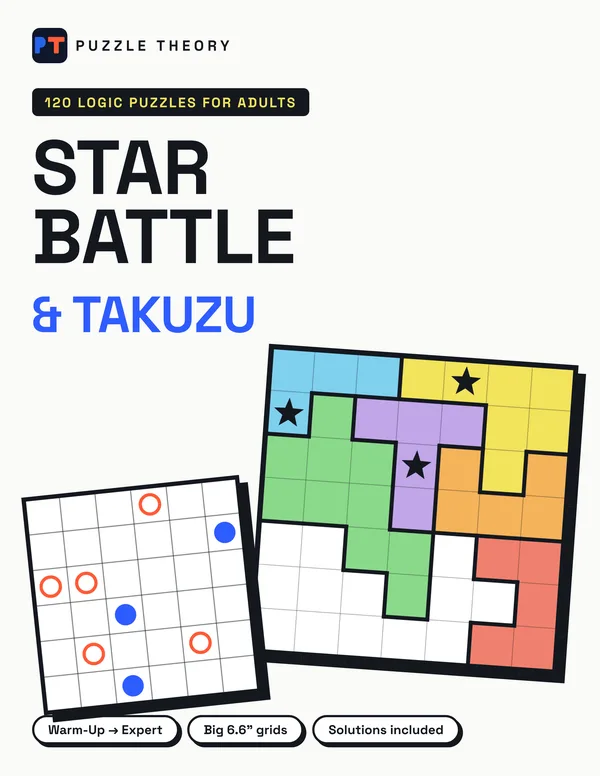
Star Battle & Takuzu
120 Logic Puzzles for Adults, Warm-Up to Expert
The paper versions of Queens and Tango: one star per row, column and region, and balanced grids of ● and ○. Big 6.6-inch grids, one puzzle per page.
- 120 puzzles, each with exactly one solution
- 3 levels: Warm-Up, Challenge, Expert
- Rules, worked examples and full solutions
If you're shopping for a younger solver, the kids' edition uses the same two puzzle types on smaller grids:
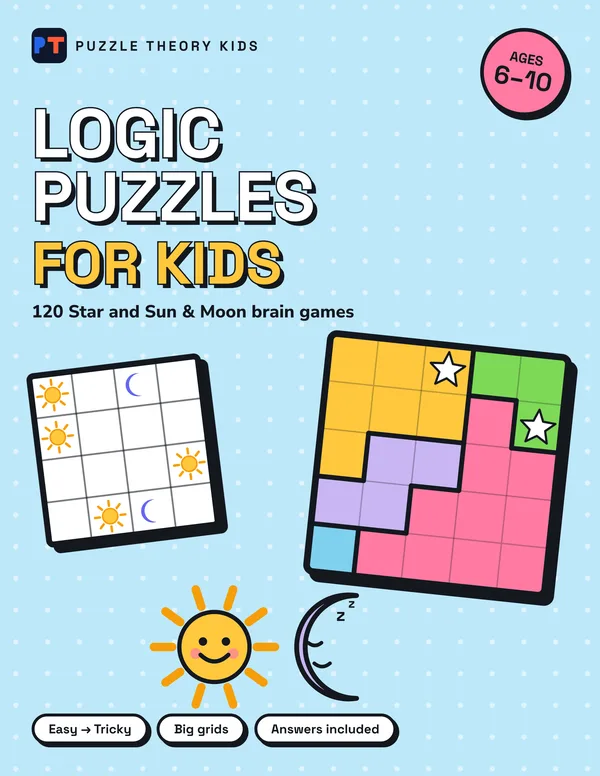
Logic Puzzles for Kids
120 Star and Sun & Moon Brain Games, Ages 6–10
Kid-sized versions of our crown and sun-and-moon puzzles, from little 4×4 grids up. Screen-free thinking for road trips, quiet time and classrooms.
- 120 puzzles in 3 levels: Easy, Medium, Tricky
- Picture rules and secret tricks
- Answers, a make-your-own page and a certificate
For tips on choosing any puzzle book, see logic puzzle books for adults: how to pick one.
Get the daily puzzle by email
One short email a day with the new puzzles. No spam, unsubscribe anytime.
Where to go next
- Try it yourself in Sudoku, or jump straight to today's board.
- Browse more logic puzzles in the same family.
- Go deeper with our best daily puzzles list.
- Missed a day? Pro members can replay the last 30 daily challenges.
Frequently asked questions
What is the best logic puzzle?
Sudoku is the most popular, but many solvers rank Star Battle, Nonograms, Slitherlink and Kakuro just as highly. The best one depends on whether you prefer numbers, shapes, lines or pictures.
Where can I play logic puzzles online for free?
Puzzle Theory has free daily logic puzzles including Queens (Star Battle), Tango (Takuzu), Plots (Shikaku), Trail (path puzzle) and Sudoku, with unlimited practice and no account.
What are Nikoli puzzles?
Nikoli is a Japanese puzzle publisher that created or popularised many logic puzzles, including Sudoku (which it named), Shikaku, Slitherlink, Nurikabe and Hashiwokakero.
What logic puzzle should I try after Sudoku?
Star Battle and KenKen keep Sudoku's row-and-column logic in new shapes, so they're natural next steps.
Do logic puzzles require math?
Most don't. Sudoku, Star Battle, Takuzu and Slitherlink use symbols or digits as labels only. Kakuro and KenKen do involve arithmetic.
Ready to play?
Seven free daily puzzles — word, number and logic. No signup, no ads in your way.