

How to Solve Star Battle Puzzles: 9 Techniques
Star Battle rules explained, plus nine solving techniques from beginner to expert: confined regions, the 2×2 rule, blocking cells and more. Works for Queens too.
Star Battle is one of the best logic puzzles you can learn in under a minute. The rules fit in one sentence, yet expert boards can keep you thinking for half an hour. It is also the puzzle behind Queens, the region-logic game many people now play every day, so everything in this guide works there too.
Below you will find the rules, the notation we use, and nine techniques in order from the first ones every beginner learns to the ones that crack expert grids. We use the one-star version throughout, which is the version in our daily game and in our Star Battle & Takuzu book.
Star Battle rules
The grid is divided into outlined regions. Place stars so that:
- Every row has exactly one star.
- Every column has exactly one star.
- Every region has exactly one star.
- No two stars touch, not even diagonally.
On a 9×9 grid there are nine rows, nine columns, nine regions and therefore nine stars. A well-made puzzle has exactly one solution, and you can always reach it without guessing.
Some books use a two-star version on bigger grids (two stars per row, column and region). The techniques are the same ideas, just applied in pairs.
Notation: stars and crosses
Before the techniques, one habit: mark the cells that cannot hold a star. Most solvers put a small cross or a dot in them. In practice you will place far more crosses than stars, and the stars appear when only one cell is left in a row, column or region.
Every time you place a star, cross out immediately:
- the rest of its row,
- the rest of its column,
- the rest of its region,
- its eight neighbours.
That alone solves most easy puzzles.
Technique 1: Single-cell regions and the last free cell
Start by scanning for anything with just one place left. A region made of one cell must hold a star. More often, as crosses build up, a row, a column or a region is left with exactly one empty cell. That cell is a star. Check rows, columns and regions in turn; beginners tend to look only at regions and miss easy wins in the lines.
Technique 2: A region confined to one line
If every cell of a region lies in the same row, that region's star must be in that row. Since each row has only one star, every other cell in that row is crossed out, even the ones in other regions. The same is true for columns.
This is the technique that opens most boards. Long, thin regions along an edge are the usual suspects.
Technique 3: Two regions in two lines
Now extend the idea. Suppose two regions together fit inside two rows (each region lies only in those rows). They need two stars, and those two rows hold exactly two stars. So the two stars of those rows belong to those two regions, and every cell in those two rows that belongs to another region is crossed out.
The rule works for any number: if N regions fit entirely inside N rows (or N columns), the rest of those lines is empty. It also works the other way round: if N rows lie entirely inside N regions, the rest of those regions is empty. Looking for these groups is the single biggest step from intermediate to advanced solving.
Technique 4: The 2×2 rule
Because stars cannot touch, any 2×2 block of cells can hold at most one star. That sounds minor, but it is a powerful counting tool.
Take two adjacent rows of a 9×9 grid. They must contain two stars. Split the two rows into 2×2 blocks (plus a leftover 2×1 strip at the end). Each block holds at most one star, so if most blocks are already full of crosses, you can work out exactly where the two stars must go. Expert setters build many of their hardest moments around this rule.
Technique 5: Cells that touch a whole region
Look at a small region, for example three cells in an L shape. Now find a cell outside it that is a neighbour of all three of its cells. If you put a star there, every cell of the little region would be touching it, and the region would have nowhere left for its star. So that outside cell must be crossed out.
The same check works for the last two or three free cells of any row or column: any cell that touches all of them can be crossed out. This technique is easy to miss because it asks you to look at a cell from the point of view of a neighbour.
Technique 6: Shapes that force a position
Some small region shapes always block the same cells around them, wherever their star ends up. Learn a few and you can cross out cells the moment you see the shape:
- A domino (two cells side by side) blocks the cells that touch both of its cells: the two cells directly above it and the two directly below it (or to the sides, for an upright domino). Whichever cell gets the star, those cells will be its neighbours.
- An L of three cells blocks the one cell that would complete it into a 2×2 square, because that cell touches all three.
- A straight line of three cells blocks the cells beside its middle cell, which touch all three.
Each of these is Technique 5 applied to a shape you will meet again and again. After a few puzzles you stop working them out and simply see them.
Technique 7: Counting what is left
When the board gets crowded, count. How many stars are still needed in the bottom three rows? How many regions still lie entirely in that part of the grid? If three rows still need three stars and three unfinished regions can only put stars in those rows, Technique 3 applies even though it was not visible at the start.
Counting is also a good way to catch a mistake. If you find that a region has no free cell left, something went wrong earlier. Better to notice now than after twenty more moves.
Technique 8: Short "what if" chains
Purists solve without trial and error, and with enough of the techniques above you rarely need it. On expert boards, though, a short chain of reasoning can help: "If the star in this region were in the top cell, it would cross out these cells, and then that row would have no place left." That means the top cell is impossible, so cross it out.
Keep these chains short (two or three steps) and do them in your head or with very light marks. This is still deduction: you are proving a cell is impossible, not guessing and hoping.
Technique 9: Work from the edges and corners
Corners and edges have fewer neighbours, so regions there have fewer options and their shapes are often more constraining. When you are stuck in the middle of the grid, go back to the edges and check each technique again. Every new cross creates new chances for Techniques 1 to 3.
A solving routine that works
Put together, a typical solve looks like this:
- Mark any single-cell regions and confined regions (Techniques 1 and 2).
- Look for N regions in N lines (Technique 3).
- Cross out cells that touch a whole region or a whole line's free cells (Techniques 5 and 6).
- Use the 2×2 rule on pairs of rows and columns (Technique 4).
- Count stars still needed in each part of the board (Technique 7).
- Only then try a short what-if chain (Technique 8).
After each star, cross out its row, column, region and neighbours, then go back to step 1. You will be surprised how often a single new star unlocks the rest.
Common mistakes
- Forgetting diagonals. The no-touching rule includes the four diagonal neighbours. It is the most common error on paper.
- Placing stars too early. Only place a star when it is proven. A wrong star can survive for many moves before the contradiction appears.
- Only looking at regions. Rows and columns break just as many boards.
- Messy marks. Use one clear symbol for "no star" and keep it small, so the grid stays readable.
How long should a Star Battle take?
There is no right answer, but as a rough guide, a beginner might spend ten to fifteen minutes on a first 7×7 board, mostly learning to see the confined regions. With a little practice the same board takes a few minutes. A 9×9 Challenge board might take fifteen to thirty minutes, and an Expert board can take much longer the first time you meet a new pattern. Speed comes from recognising shapes and groups at a glance, so do not worry about the clock early on. Focus on making only proven moves, and the speed will follow.
Where to practise Star Battle
To build these habits, play a little every day. Our daily Queens board uses exactly these rules, with a new verified puzzle each day and unlimited practice. If you want to see how it compares with the one on LinkedIn, read Queens puzzle vs LinkedIn Queens.
Star Battle on paper
If you would rather practise with a pencil, our book Star Battle & Takuzu has 60 Star Battle puzzles that grow in the same order as this guide. The Warm-Up 7×7 boards are perfect for practising Techniques 1 and 2, the Challenge 9×9 boards start to need the group and blocking techniques, and the Expert boards are where counting and the 2×2 rule really pay off. Every puzzle has exactly one solution, and full solutions are in the back. The other half of the book is Takuzu, the balanced-grid puzzle behind our Tango game.
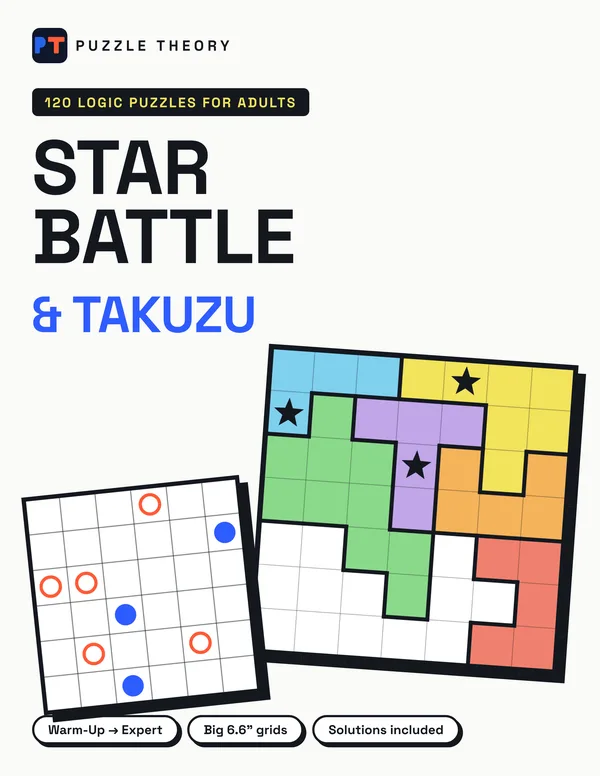
Star Battle & Takuzu
120 Logic Puzzles for Adults, Warm-Up to Expert
The paper versions of Queens and Tango: one star per row, column and region, and balanced grids of ● and ○. Big 6.6-inch grids, one puzzle per page.
- 120 puzzles, each with exactly one solution
- 3 levels: Warm-Up, Challenge, Expert
- Rules, worked examples and full solutions
Get the daily puzzle by email
One short email a day with the new puzzles. No spam, unsubscribe anytime.
Where to go next
- Try it yourself in Sudoku, or jump straight to today's board.
- Browse more logic puzzles in the same family.
- Go deeper with our best daily puzzles list.
- Missed a day? Pro members can replay the last 30 daily challenges.
Frequently asked questions
What are the rules of Star Battle?
Place stars so every row, column and outlined region has exactly one star (two in some larger versions), and no two stars touch each other, including diagonally.
Is Star Battle the same as Queens?
Yes, the one-star version of Star Battle uses the same rules as Queens: one per row, column and region, with no two touching. Only the symbol changes.
What is the best way to start a Star Battle puzzle?
Look for regions that fit entirely in one row or column. Their star must be in that line, so you can cross out every other cell of that row or column straight away.
Do you have to guess in Star Battle?
No. A well-made Star Battle puzzle has exactly one solution and can be solved by deduction alone. On hard boards, short what-if chains help you prove a cell is impossible.
Where can I find Star Battle puzzles?
You can play the same rules free every day as Queens on Puzzle Theory, or solve 60 Star Battle puzzles on paper in our Star Battle & Takuzu book on Amazon.
Ready to play?
Seven free daily puzzles — word, number and logic. No signup, no ads in your way.