

Number Puzzle Games & Mental Math Tricks
The best number puzzle games for mental math, the arithmetic tricks that make them easier, and a complete guide to Target and Countdown-style number rounds.
Most of us stopped doing arithmetic in our heads the day phones got calculators. Number puzzle games bring it back in a form that's actually fun: short daily challenges where a bit of mental maths is the whole point. This guide covers the best number puzzle games, the mental math tricks that make them easier, and a complete strategy for Target and other Countdown-style number rounds.
Why number puzzles are good practice
Mental arithmetic is a skill like any other: it gets faster and more reliable with regular practice. Number puzzles give you that practice with a goal, which makes it far more pleasant than drilling times tables. You'll also practise planning: holding a few intermediate results in your head while you try different routes to a target. We're careful with bigger claims; research suggests you mostly improve at the kind of task you practise. But if you want to be quicker with numbers, practising with numbers works.
The best number puzzle games
Target (Countdown-style numbers)
Target gives you six numbers and a three-digit target. Combine the numbers with addition, subtraction, multiplication and division to hit the target exactly; each number can be used once. It's the format made famous by the numbers round of the TV show Countdown, and it rewards creativity: there are usually several ways to get there.
Equate and Nerdle (equation guessing)
Guess a hidden equation in six tries with Wordle-style feedback for every digit and operator. It's less about speed and more about logic and arithmetic together. Equate is our free version; our guide to math Wordle alternatives covers the genre.
Sudoku and other number placement puzzles
Sudoku uses digits but no arithmetic at all, so it trains logic rather than mental maths. Kakuro and KenKen, by contrast, combine placement with sums and products and are great for arithmetic practice.
Domino Regions
Domino Regions asks you to place dominoes so that every coloured region meets its sum, equality or comparison rule. Lots of small additions, wrapped in a logic puzzle.
Prefer paper?
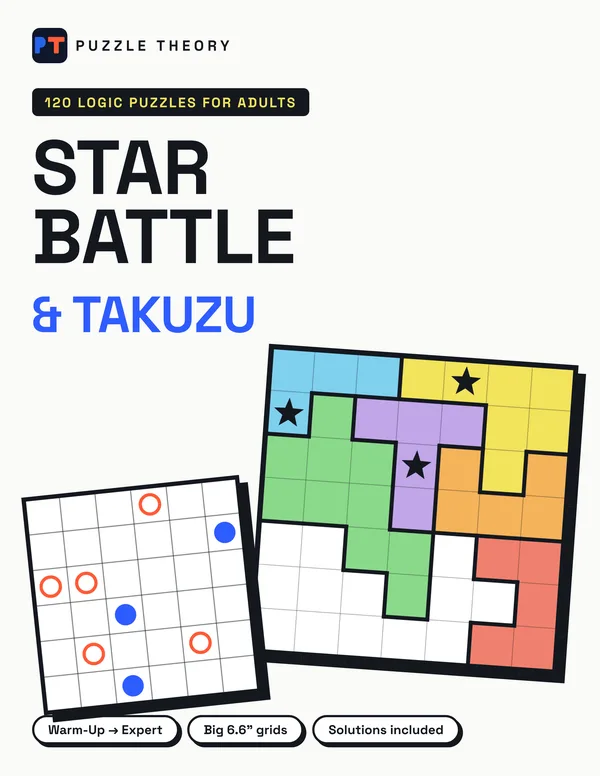
Star Battle & Takuzu
120 Logic Puzzles for Adults, Warm-Up to Expert
The paper versions of Queens and Tango: one star per row, column and region, and balanced grids of ● and ○. Big 6.6-inch grids, one puzzle per page.
- 120 puzzles, each with exactly one solution
- 3 levels: Warm-Up, Challenge, Expert
- Rules, worked examples and full solutions
Five mental math tricks that pay off
These shortcuts come up constantly in number games, and each one takes an afternoon to learn.
- Add in chunks. For 47 + 38, add 40 to get 87, then 7 to get 94 (rounding 38 to 40 and subtracting 2 works too). Breaking numbers into tens and units keeps everything in your head.
- Multiply by 25, 50 and 75 with fractions. Multiplying by 25 is dividing by 4 and multiplying by 100: 25 × 16 = 1600 ÷ 4 = 400. Times 50 is half of times 100, and times 75 is three times 25.
- Use near-hundreds. 99 × 7 is 700 − 7 = 693. 101 × 6 is 600 + 6 = 606. Many Target solutions hide inside a "hundred minus a little" step.
- Double and halve. 16 × 25 is the same as 8 × 50, which is 4 × 100 = 400. Halving one number and doubling the other often turns a hard product into an easy one.
- Work backwards from the target. If the target is 452, ask which big product is close: 450 is 9 × 50, or 4.5 × 100. Then fix the small difference with the numbers left over.
How to solve Target (and Countdown numbers)
Here's a routine that works on almost every board:
- Look at the large numbers first. Target uses large numbers like 25, 50, 75 and 100 alongside small ones. Ask what multiples of the large numbers land near the target.
- Find a near miss. Get within ten or so of the target with one multiplication, then use the remaining small numbers to close the gap.
- Build the small correction separately. If you're 7 short, can two of the small numbers make 7 (say 10 − 3)? Keep that as a side calculation.
- Keep a spare. Try not to use every number in your main route; a spare small number gives you room to adjust.
- Check the division. Division must come out exact, so it's most useful with the large numbers: 75 ÷ 3 = 25, 100 ÷ 4 = 25.
A worked example: numbers 100, 75, 6, 4, 3, 2 and target 452. The obvious start, 4 × 100 = 400, leaves 52 to build from 75, 6, 3 and 2, which is awkward. Try the other large number instead: 75 × 6 = 450, and 450 + 2 = 452. Two operations, done. The lesson: multiplying a large number by a small one often lands closer than starting with 100.
Choosing a difficulty
Target has three levels. Gentle (free) uses more large numbers and smaller targets (100 to 399), which is a good place to learn the routine. Standard (Pro) gives the classic range of 100 to 999. Brutal (Pro) uses only one large number and big targets (500 to 999), so you'll need multiplication tricks and more creativity. If you can't find an exact solution, the game keeps track of your closest result, and you can reveal a solution to learn from it.
Common mistakes in Target
- Starting with 100 by habit. 100 is tempting, but multiplying 75, 50 or 25 by a small number often lands closer.
- Using every number too early. Keep at least one small number in reserve for the final adjustment.
- Forgetting subtraction and division. Some targets are easiest to reach from above: overshoot with a big product, then subtract.
- Losing track of intermediate results. Say each step out loud or jot it down. Most "almost solved" boards fail because a middle result was misremembered.
Number games for kids and families
Number puzzles are a great family activity because they turn arithmetic into a game. With younger children, play Target together on the Gentle level and let them suggest the next step. Mini Sudoku, simple dominoes puzzles and "make 10" games (find pairs that add up to ten) build confidence early. Older children often enjoy racing a parent to the target, and it's surprising how quickly their mental arithmetic improves when there's a game to win.
A two-minute daily drill
If you want faster mental arithmetic without playing a full game, try this: pick any three-digit number you see today, on a receipt, a bus or a clock, and make it from 25, 50, 75 or 100 plus small numbers in your head. It takes a minute or two and trains exactly the skills Target rewards.
Why the numbers round is so popular
The numbers game made famous by Countdown has been a television staple for decades, and it's easy to see why. The rules are simple, the pressure of a ticking clock is exciting, and there's real creativity in the answers: two players often reach the same target by completely different routes. It's also beautifully fair. There's no luck once the numbers are drawn, just arithmetic and imagination. Daily number games bring the same feeling to your phone, without the thirty-second clock unless you want one.
Make it a daily habit
The best way to get faster at mental maths is little and often. One Target round in the morning, or an Equate puzzle on the train, is enough to notice a real difference within a few weeks. Both have a free daily puzzle plus unlimited practice. For more short games to fit into your day, see our list of 5-minute brain games, and for the science behind brain training, read brain training games: what actually works.
Prefer paper?
Our puzzles, in a book
Star Battle & Takuzu
120 Logic Puzzles for Adults, Warm-Up to Expert
The paper versions of Queens and Tango: one star per row, column and region, and balanced grids of ● and ○. Big 6.6-inch grids, one puzzle per page.
- 120 puzzles, each with exactly one solution
- 3 levels: Warm-Up, Challenge, Expert
- Rules, worked examples and full solutions
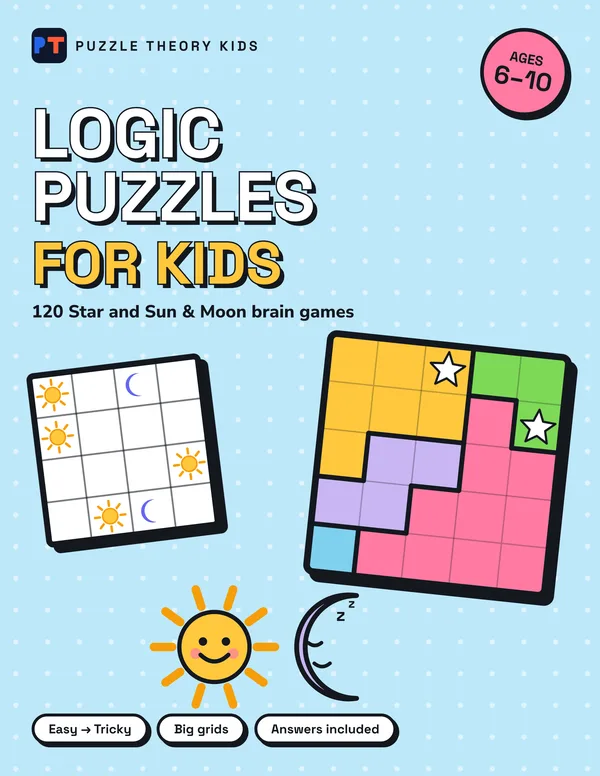
Logic Puzzles for Kids
120 Star and Sun & Moon Brain Games, Ages 6–10
Kid-sized versions of our crown and sun-and-moon puzzles, from little 4×4 grids up. Screen-free thinking for road trips, quiet time and classrooms.
- 120 puzzles in 3 levels: Easy, Medium, Tricky
- Picture rules and secret tricks
- Answers, a make-your-own page and a certificate
Get the daily puzzle by email
One short email a day with the new puzzles. No spam, unsubscribe anytime.
Where to go next
- Try it yourself in Target, or jump straight to today's board.
- Browse more number puzzles in the same family.
- Go deeper with the Target mental-math guide.
- Missed a day? Pro members can replay the last 30 daily challenges.
Frequently asked questions
What are the best number puzzle games for mental math?
Countdown-style games like Target, equation guessing games like Equate and Nerdle, and sum-based puzzles like Kakuro, KenKen and Domino Regions all give regular mental arithmetic practice.
How do you solve Countdown numbers puzzles faster?
Start with the large numbers, find a multiplication that lands near the target, then build the small correction from the remaining numbers. Working backwards from the target also helps.
What mental math tricks help with number games?
Adding in chunks, multiplying by 25 as dividing by 4, using near-hundreds like 99 × 7 = 700 − 7, doubling and halving, and working backwards from the target.
Do number puzzles improve your maths?
Regular practice makes mental arithmetic faster and more reliable. Research suggests the gains are mostly in the kind of task you practise, so practise with numbers if numbers are the goal.
Is Target free to play?
Yes. Target has a free daily puzzle and unlimited practice, with harder levels available on Pro.
Ready to play?
Seven free daily puzzles — word, number and logic. No signup, no ads in your way.