

Sudoku Techniques for Beginners: Solve Faster
Every Sudoku technique a beginner needs, in the order to learn them: scanning, singles, pairs, pointing and X-Wing, plus how to read the grid and get faster.
Sudoku has one of the simplest rule sets in puzzling: fill a 9×9 grid so that every row, every column and every 3×3 box contains the digits 1 to 9 exactly once. No arithmetic is involved; the digits could just as well be letters or colours. Yet the same rules produce puzzles that take three minutes or three hours. The difference is technique. This guide walks through the techniques in the order you should learn them, from your very first grid to the patterns that crack hard puzzles, and finishes with habits that make you faster.
How to read a Sudoku grid
Before any technique, learn to see the grid in three ways at once. Every cell belongs to one row, one column and one box, and those three groups are called its "units". A digit placed in a cell rules that digit out of every other cell in its row, column and box. Every technique below is just a clever way of tracking those exclusions.
Two habits help from day one:
- Count the givens per digit. If there are already six 7s on the board, only three 7s are missing, and they are usually easy to find.
- Look at boxes, not just lines. Beginners scan rows and columns and forget the boxes, where many of the easiest placements hide.
Technique 1: Scanning (cross-hatching)
Pick a digit, say 5, and a box that doesn't contain a 5 yet. Look at the rows and columns passing through that box. Every row or column that already has a 5 elsewhere rules out its cells inside the box. If only one empty cell in the box survives, it's the 5.
Scanning is the bread and butter of Sudoku. On easy puzzles it does almost all the work. Go through the digits 1 to 9 in order, scanning every box, and you'll place a surprising number of digits before any real thinking is needed.
Technique 2: Naked single
Sometimes it's easier to look at a cell than at a digit. Take an empty cell and list the digits already used in its row, column and box. If eight different digits are excluded, the ninth is the answer. This is called a naked single, and it's especially useful late in a puzzle when the grid is crowded.
Technique 3: Hidden single
A hidden single is the mirror image. Within one unit (a row, column or box), a digit might have only one possible cell left, even though that cell has several candidates of its own. Scanning finds these in boxes; the same reasoning works in rows and columns. Whenever you place a digit, check its row, column and box for new hidden singles, because each placement creates a few.
Pencil marks: when and how
On medium and hard puzzles, singles eventually dry up. That's when you need pencil marks (also called candidates): small notes in each cell listing the digits that could still go there. Two styles are common:
- Full candidates: write every possible digit in every empty cell. Thorough but slow by hand; ideal in an app that fills them for you.
- Snyder notation: only mark a digit in a box when it has exactly two possible cells. Faster, and it makes pairs jump out.
Whichever you use, update the marks every time you place a digit. Out-of-date marks are the number one cause of mistakes.
Prefer paper?
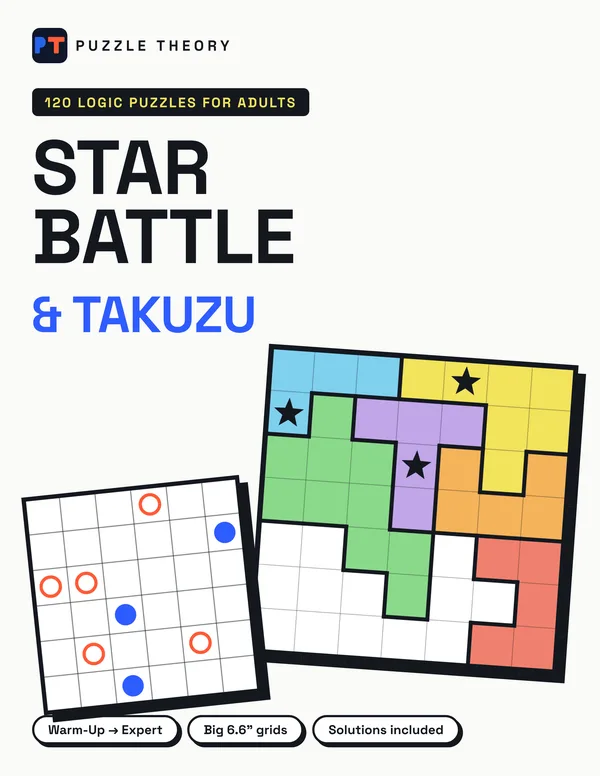
Star Battle & Takuzu
120 Logic Puzzles for Adults, Warm-Up to Expert
The paper versions of Queens and Tango: one star per row, column and region, and balanced grids of ● and ○. Big 6.6-inch grids, one puzzle per page.
- 120 puzzles, each with exactly one solution
- 3 levels: Warm-Up, Challenge, Expert
- Rules, worked examples and full solutions
Technique 4: Naked pairs (and triples)
If two cells in the same unit both contain only the same two candidates, say {3, 8}, then 3 and 8 must go in those two cells, in some order. That means you can remove 3 and 8 from every other cell in that unit. The same logic works for three cells sharing three candidates (a naked triple), even if not every cell has all three.
Hidden pairs are the reverse: if two digits can only go in the same two cells of a unit, those cells can't hold anything else, so you can clear their other candidates.
Technique 5: Pointing pairs and box-line reduction
These two techniques use the overlap between a box and a line.
- Pointing: if, inside a box, all the candidates for a digit sit in one row, that digit must be in that row within the box. So it can be removed from the rest of that row outside the box.
- Box-line reduction: if, inside a row, all the candidates for a digit fall within one box, the digit can be removed from the other cells of that box.
They sound abstract, but once you've spotted a couple you'll see them everywhere. They often unlock a single that was hiding in plain sight.
Technique 6: X-Wing
X-Wing is the first "advanced" pattern most players learn. Suppose a digit, say 4, has exactly two possible cells in row 2 and exactly two in row 7, and those cells line up in the same two columns. Then the two 4s must sit at opposite corners of that rectangle, whichever way round. Either way, each of those two columns gets its 4 from rows 2 and 7, so 4 can be removed from every other cell in those two columns. The same pattern works with columns and rows swapped.
You won't need X-Wing on easy or medium puzzles, but it's the key to many hard ones.
How to solve Sudoku faster
Speed comes from doing the cheap techniques first and in a fixed order. A routine that works:
- Sweep all digits 1–9 with scanning, starting with the digits that appear most often.
- Check naked singles in the most crowded rows, columns and boxes.
- After each placement, recheck its row, column and box for new singles. Placements come in chains.
- Only then add pencil marks and look for pairs, pointing and box-line reductions.
- Save X-Wing and other patterns for when everything else is stuck.
Two more tips: don't guess (a well-made Sudoku never requires it, and a wrong guess can cost the whole grid), and play regularly. Recognition is what makes experts fast, and recognition comes from volume.
Common beginner mistakes
- Writing a digit "because it probably goes there". If you can't explain why a digit must go in a cell, it doesn't belong there yet.
- Forgetting to update pencil marks. Every placed digit removes candidates from its row, column and box. Stale marks lead to wrong deductions several moves later.
- Scanning only rows and columns. Boxes hide the easiest placements. Check all three kinds of unit every time.
- Fixing mistakes by erasing one digit. If you find a contradiction, the error is often several moves back. On a hard grid it can be faster to restart than to hunt for it.
Practise at the right level
The best practice is a puzzle that's slightly too hard. Our free Sudoku has a new daily grid plus unlimited practice. Easy boards start with 42 givens, enough for scanning and singles alone. Medium (32 givens) and Hard (26 givens) are part of Pro and need the pair techniques; keep a scrap of paper handy for candidate notes on the hardest grids. Every board has exactly one solution.
Practise on paper
Many of these techniques are easier to learn with a pencil, where you can write candidates in the corners of each cell. Our free printable pack has 12 Sudoku puzzles, six Easy and six Medium, with a rules page and full solutions.
Free printable puzzle packs
Print-ready PDFs with the rules, 10 to 12 puzzles and every answer. Tick as many packs as you like, and print as many copies as you want for home or the classroom.
Where to go next
Once you're comfortable with the techniques above, try a puzzle with the same "only one place left" logic in a different shape. Queens and its paper cousin Star Battle use rows, columns and regions just like Sudoku, but with stars instead of digits. Our Star Battle solving guide shows how much of your Sudoku thinking carries over. For a wider tour, see the best logic puzzle games, or compare places to play in our guide to the best free online Sudoku.
Prefer paper?
Our puzzles, in a book
Star Battle & Takuzu
120 Logic Puzzles for Adults, Warm-Up to Expert
The paper versions of Queens and Tango: one star per row, column and region, and balanced grids of ● and ○. Big 6.6-inch grids, one puzzle per page.
- 120 puzzles, each with exactly one solution
- 3 levels: Warm-Up, Challenge, Expert
- Rules, worked examples and full solutions
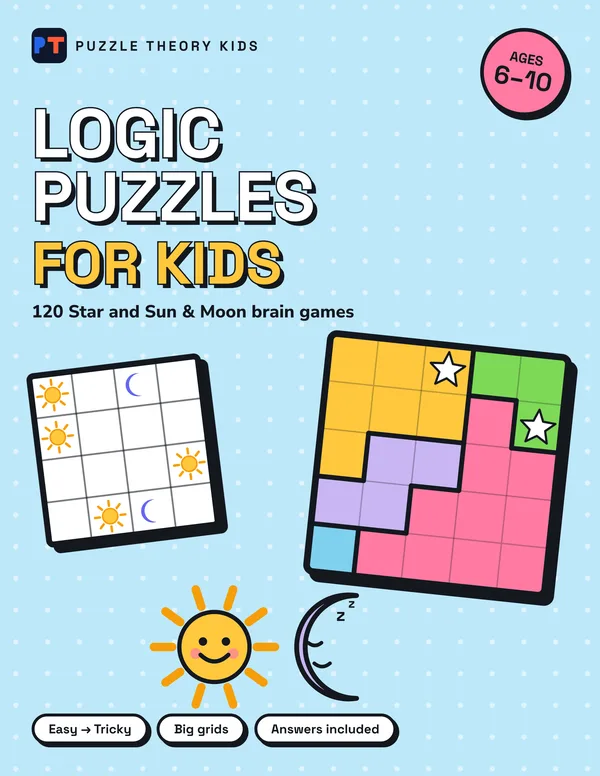
Logic Puzzles for Kids
120 Star and Sun & Moon Brain Games, Ages 6–10
Kid-sized versions of our crown and sun-and-moon puzzles, from little 4×4 grids up. Screen-free thinking for road trips, quiet time and classrooms.
- 120 puzzles in 3 levels: Easy, Medium, Tricky
- Picture rules and secret tricks
- Answers, a make-your-own page and a certificate
Get the daily puzzle by email
One short email a day with the new puzzles. No spam, unsubscribe anytime.
Where to go next
- Try it yourself in Sudoku, or jump straight to today's board.
- Browse more logic puzzles in the same family.
- Go deeper with our best daily puzzles list.
- Missed a day? Pro members can replay the last 30 daily challenges.
Frequently asked questions
What is the first Sudoku technique to learn?
Scanning, also called cross-hatching: pick a digit and a box, rule out cells using that digit in the crossing rows and columns, and place it when one cell is left.
What is the difference between a naked single and a hidden single?
A naked single is a cell with only one possible digit. A hidden single is a digit with only one possible cell in a row, column or box, even if that cell has other candidates.
How can I solve Sudoku faster?
Use a fixed routine: scan every digit, check naked singles, recheck each placement's row, column and box, and only then add pencil marks for pairs and pointing.
Do you ever have to guess in Sudoku?
No. A well-made Sudoku has exactly one solution that can be reached by logic alone. Guessing usually leads to mistakes that are hard to undo.
What is an X-Wing in Sudoku?
A pattern where a digit has exactly two possible cells in each of two rows, lined up in the same two columns. The digit can then be removed from the rest of those columns.
Ready to play?
Seven free daily puzzles — word, number and logic. No signup, no ads in your way.