

Brain Training Games: What Actually Works
Do brain games make you smarter? What the research says about brain training, focus and puzzles, what's worth your time, and how to build a habit that helps.
Brain training is a huge business, built on a simple promise: play a few games a day and you'll become sharper, more focused and better protected against ageing. We make puzzle games, so we'd love that promise to be true. The honest answer is more interesting. This guide summarises what the research actually says, what puzzles are genuinely good for, and how to build a daily habit that's worth your time.
What "brain training" claims
Most brain training products promise transfer: that getting better at their games will make you better at other things, like remembering names, concentrating at work or reasoning in general. Psychologists distinguish two kinds:
- Near transfer: improving at tasks very similar to the one you practised. Practise mental arithmetic and you get faster at mental arithmetic.
- Far transfer: improving at unrelated abilities. Practise a memory game and become better at your job, or less likely to develop dementia.
Near transfer is well established. Far transfer is where the evidence gets thin.
What the research says
A few landmarks are worth knowing:
- A large online study published in Nature in 2010 had more than 11,000 adults train on reasoning and memory tasks for six weeks. They improved on the trained tasks, but showed no meaningful gains on untrained tests of thinking.
- In 2014, a group of around seventy researchers signed a public statement saying the marketing claims of brain games weren't supported by the evidence. Another group of scientists responded that some training did show promise, which tells you the field was genuinely divided.
- In 2016, the US Federal Trade Commission reached a settlement with the maker of a popular brain training app over advertising claims about preventing cognitive decline and improving performance at work and school.
- A major 2016 review of the published studies concluded that training reliably improves the trained tasks, has smaller effects on closely related tasks, and has little convincing evidence of improving everyday cognitive performance.
- Some long-running trials in older adults have reported encouraging results for specific kinds of training, such as speed-of-processing exercises, but the findings are debated and not a general endorsement of brain games.
The fair summary: you get better at what you practise. Puzzles are excellent practice for the skills puzzles use, and there's little evidence that any game is a shortcut to general intelligence.
So what are puzzles actually good for?
Quite a lot, as long as the promises are realistic.
Focus. A puzzle asks for a few minutes of single-minded attention, something modern life rarely does. Practising sustained attention on a puzzle won't rewire your brain, but it's a pleasant way to take a break from notifications and switch into a calmer mode.
Specific skills. Logic puzzles practise careful reasoning and checking. Word games practise vocabulary and spelling patterns. Number games practise mental arithmetic. If you want those skills, puzzles are a fun way to get them.
Mood and routine. A small daily challenge that you can finish gives a reliable sense of accomplishment. Many people use a morning puzzle as a ritual that marks the start of the day, the same way others use a walk or a coffee.
Social connection. Sharing a daily score with friends or family is a light, low-pressure way to stay in touch. For many players this is the best part.
Staying mentally active. Health organisations generally encourage staying mentally, physically and socially active as we age. Puzzles are one enjoyable way to stay mentally active, alongside learning new skills, reading and conversation. They're a good habit, not a treatment.
Myths and facts
- Myth: brain games raise your IQ. There's no convincing evidence that playing puzzles increases general intelligence.
- Fact: you get better at what you practise. Play Sudoku and you'll become a much better Sudoku solver, and somewhat better at similar logic puzzles.
- Myth: more is always better. Long sessions bring diminishing returns. Short, regular practice is more effective and easier to keep up.
- Fact: variety helps engagement. Switching between word, number and logic puzzles keeps the habit interesting, which is what makes it last.
- Myth: you need a special app. Any challenging, enjoyable puzzle gives you the same kind of practice, whether it's in an app, a newspaper or a book.
Puzzles at every age
Puzzles suit every stage of life, and the benefits look a bit different at each. Children practise patience, rule-following and reasoning, and get the confidence of solving something on their own. Busy adults get a focused break and a small daily win. Older adults often value puzzles as one part of a mentally and socially active routine, especially when they're shared with family or friends. The common thread is enjoyment: the puzzles people keep playing are the ones that are fun.
How to build a puzzle habit that helps
- Keep it short. Five to fifteen minutes a day beats an hour once a week. Daily puzzles are designed for exactly this.
- Mix the types. A word game, a number game and a logic puzzle each use different skills. Variety keeps it interesting and stretches you in different directions.
- Stay at the edge of your ability. If every puzzle is easy, you're relaxing (which is fine) but not learning. Move up a difficulty level when you're finishing quickly.
- Learn techniques, don't just play. Reading a short strategy guide often does more than another twenty games. Our guides to Sudoku techniques and Star Battle are good places to start.
- Put the phone down sometimes. Paper puzzles give you the same challenge without notifications pulling you away.
What to look for in a brain game
- A real challenge with a clear goal. Puzzles that make you think, with a definite solution, beat games that reward fast tapping.
- Adjustable difficulty, so the game grows with you.
- Short sessions that fit into daily life.
- Honest marketing. Be wary of any app that promises to raise your IQ, sharpen your memory in days or prevent dementia.
- Fun. The game you enjoy is the one you'll keep playing, and consistency is where the real benefit lies.
Paper or screen?
Both work. Screens are convenient and give you a new puzzle every day. Paper removes the distractions that make focus hard in the first place, and many people find they reason more carefully with a pencil. If that appeals, our logic puzzle book collects 120 puzzles from the same generators as our daily games:
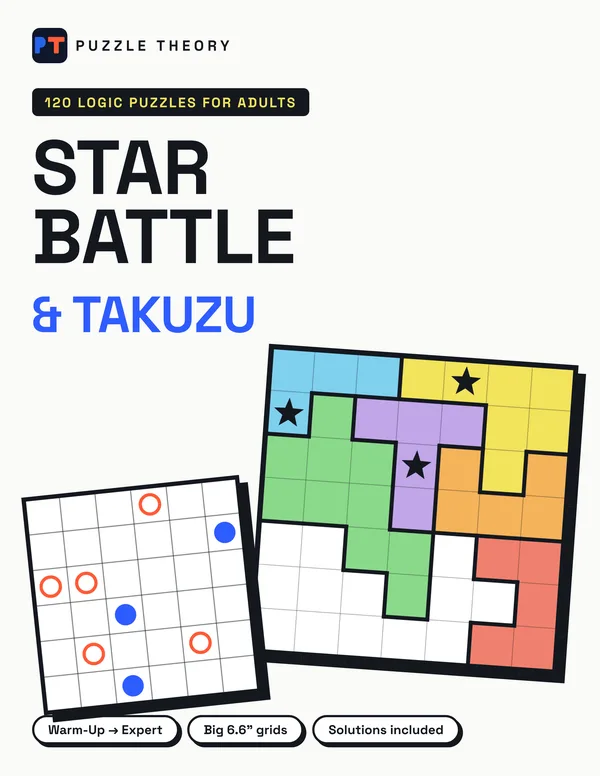
Star Battle & Takuzu
120 Logic Puzzles for Adults, Warm-Up to Expert
The paper versions of Queens and Tango: one star per row, column and region, and balanced grids of ● and ○. Big 6.6-inch grids, one puzzle per page.
- 120 puzzles, each with exactly one solution
- 3 levels: Warm-Up, Challenge, Expert
- Rules, worked examples and full solutions
A word of caution
Puzzles are a pleasant habit, not a medical tool. If you or someone close to you notices memory or concentration problems that are new or getting worse, talk to a doctor. Many causes are treatable, and no game is a substitute for proper advice.
A balanced daily routine
Here's a ten-minute routine we like:
- A word game: Lexicon or Hive for vocabulary and deduction.
- A number game: Target for mental arithmetic.
- A logic puzzle: Queens, Tango or Sudoku for careful reasoning.
All of them have a free daily puzzle at 00:00 UTC, the same for everyone, plus unlimited practice. Play them because they're fun and you'll get the real benefits: a calmer break, a sharper set of puzzle skills and something to share. For quick ideas, see our list of 5-minute brain games for your morning.
Get the daily puzzle by email
One short email a day with the new puzzles. No spam, unsubscribe anytime.
Where to go next
- Try it yourself in Lexicon, or jump straight to today's board.
- Browse more brain games in the same family.
- Missed a day? Pro members can replay the last 30 daily challenges.
Frequently asked questions
Do brain training games really work?
They reliably make you better at the trained games and closely related tasks. Evidence that they improve general intelligence or everyday memory is weak.
Are daily puzzles good for you?
They're a good habit: a focused break, practice for specific skills like logic or vocabulary, and a way to stay mentally active. They're not a medical treatment.
Can puzzles improve focus?
Puzzles give you regular practice at sustained attention and a break from distractions. They're a pleasant way to practise focusing, though they won't transform concentration on their own.
How long should I play brain games each day?
Five to fifteen minutes a day is plenty. Short, regular sessions are better than long occasional ones.
Are paper puzzles better than apps?
Both work. Paper removes notifications and distractions, which many people find helps them concentrate; apps are convenient and offer a new puzzle every day.
Ready to play?
Seven free daily puzzles — word, number and logic. No signup, no ads in your way.