

LinkedIn Patches Alternative: Free Area Puzzle
A free alternative to LinkedIn's Patches: how rectangle-splitting puzzles work, where they come from (Shikaku), and where to play Plots daily with unlimited practice.
LinkedIn's Patches asks you to do something very satisfying: take a messy grid of numbers and cut it into neat rectangles, each one exactly the right size. When the last piece clicks into place, the whole board turns into a tidy patchwork. It's calm, visual and over in a few minutes, which makes it a perfect daily ritual. It also leaves a lot of players wanting a second board.
This guide explains the puzzle behind Patches, what makes a good one, and where to play Plots, our free daily version, with unlimited practice and no account.
The puzzle behind Patches: Shikaku
Patches is a modern twist on a classic Japanese logic puzzle called Shikaku, which roughly means "divide by squares". Shikaku was popularised by Nikoli, the publisher that also gave the world many of the logic puzzles you see in newspapers. The rules have stayed the same for decades:
- Divide the grid into rectangles (squares count too).
- Each rectangle contains exactly one number.
- That number equals the rectangle's area.
Patches adds shape hints: a small icon tells you whether a number's rectangle is a square, wider than it is tall, or taller than it is wide. Those hints make the puzzle friendlier and quicker, which suits a daily game.
Why players look for an alternative
The daily format is great for habits, but it comes with limits:
- One board a day. Finished in two minutes? You wait until tomorrow.
- An account is required. LinkedIn's games are inside LinkedIn, so you need to sign in.
- No way to practise. You can't try a technique twice in a row.
If any of these bother you, a standalone version is the answer.
Plots: our free daily area puzzle
Plots follows the same rules as Patches. Split the grid into rectangles, give each rectangle exactly one number, make its area equal to that number, and respect the shape icon when one is shown. Here's what you get:
- A new daily board at 00:00 UTC, the same for everyone.
- Unlimited practice, with a fresh board each time.
- Two levels. Normal is a 6×6 board where every number shows its shape, close to the Patches experience. Hard (Pro) is an 8×8 board where most shape hints are hidden, which is closer to classic Shikaku and needs more reasoning.
- No account, unless you want to save streaks and appear on the leaderboard.
- Simple controls. Drag from one corner to the opposite corner to draw a rectangle. Drawing over existing rectangles replaces them, and tapping a rectangle removes it.
Every Plots board is checked by a solver before it's served. The generator cuts the grid into random rectangles, places one number in each, and then confirms that only one layout fits all the clues. On Hard, it reveals a shape hint only where a second layout would otherwise fit. You never have to guess.
Prefer paper?
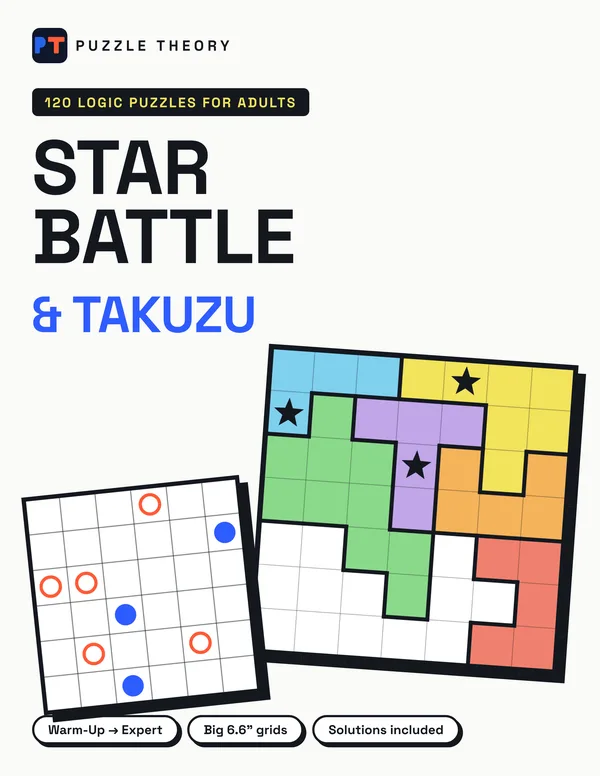
Star Battle & Takuzu
120 Logic Puzzles for Adults, Warm-Up to Expert
The paper versions of Queens and Tango: one star per row, column and region, and balanced grids of ● and ○. Big 6.6-inch grids, one puzzle per page.
- 120 puzzles, each with exactly one solution
- 3 levels: Warm-Up, Challenge, Expert
- Rules, worked examples and full solutions
How Plots compares with Patches
- Daily board: both free. Patches needs a LinkedIn account; Plots doesn't.
- Practice: Patches has one board a day; Plots adds unlimited practice.
- Difficulty: Plots lets you choose between full shape hints (Normal) and mostly hidden hints (Hard).
- Extras: Plots has a timer, a share card and a leaderboard.
The skills are the same, so playing one makes you better at the other.
Normal or Hard: which should you pick?
If you play Patches regularly, start with Normal. Every number shows its shape, the board is 6×6, and the experience is close to what you know. Most players solve their first Normal boards in a few minutes and quickly get under a minute.
Move to Hard when you notice that you're barely looking at the shape icons any more. On an 8×8 board with most hints hidden, a 6 could be a 1×6 line in either direction or a 2×3 block either way round, so you have to work out each rectangle's shape from its surroundings. That's classic Shikaku, and it's where the deeper techniques start to matter.
Playing on your phone
Area puzzles are perfect for a phone. In Plots, put your finger on one corner of the rectangle you want, slide to the opposite corner and lift. The rectangle's area appears as you drag, so you can see when you've reached the right size before letting go. Drawing over existing rectangles replaces them, which makes corrections quick, and a single tap on a rectangle removes it. Rectangles that break a rule are outlined with a dashed red line, so you can spot mistakes at a glance.
A little history
Shikaku is one of many pencil puzzles popularised by Nikoli, the Japanese publisher that also helped make Sudoku a worldwide hit. Like Sudoku, it spread because the rules are tiny and language-free, so anyone can pick it up. It appears in puzzle magazines and books around the world, sometimes under other names such as "Rectangles" or "Divide by Squares". Patches brought it to a new audience as a daily game, and the shape hints were a clever way to make it more welcoming for players who had never seen it before.
Your first board in three steps
- Start with the big numbers near edges and corners. A 6 squeezed into a corner, or a number whose shape hint only fits one way, often has a single possible rectangle.
- Check who can reach each empty cell. If only one number's rectangle could possibly cover a cell, that cell belongs to it.
- Think in factors. A 5 or a 7 can only be a straight line. A 4 is a line or a 2×2 square, and a 6 is a 1×6 line or a 2×3 block.
Our Plots and Shikaku solving guide covers these ideas in depth, with a step-by-step routine.
More daily puzzles for Patches fans
If you like puzzles where the whole board comes together at once, try these:
- Trail: draw one line through every cell, our free version of LinkedIn's Zip. See the Zip alternative guide.
- Queens: one crown per row, column and coloured region. Compare it in Queens vs LinkedIn Queens.
- Tango: balance suns and moons in every line.
- Sudoku: the classic that started the daily logic habit for many players.
Why area puzzles are so relaxing
Area puzzles have a different rhythm from word games or quizzes. There's no clock-watching or trivia to recall. You look, you notice, and pieces fall into place one after another. Many players describe Plots and Patches as calming, a puzzle you can do with a coffee rather than one that makes you tense. The visual reward helps too: every correct rectangle fills with colour, so you can see your progress at a glance.
There's real thinking underneath, though. You're constantly weighing a number's possible shapes against its neighbours, and on harder boards you'll find yourself reasoning about which number "owns" a lonely cell. That mix of calm and logic is what keeps people coming back.
Make it a daily habit
The easiest way to stick with any daily puzzle is to tie it to something you already do. Plenty of players solve the daily Plots board with their morning coffee, then play a Trail and a Queens board on the train. A new board arrives every day at 00:00 UTC, and your streak counts every day you solve the daily puzzle, so a few minutes is all it takes to keep it going. If you share your result, your friends see your time without seeing the solution, which makes it a nice way to start a friendly competition.
Ready to start cutting?
Patches made Shikaku feel fresh again. Plots lets you enjoy it whenever you want: a daily board to share, unlimited practice to improve, and a harder mode when the shape hints start to feel like training wheels.
Prefer paper?
Our puzzles, in a book
Star Battle & Takuzu
120 Logic Puzzles for Adults, Warm-Up to Expert
The paper versions of Queens and Tango: one star per row, column and region, and balanced grids of ● and ○. Big 6.6-inch grids, one puzzle per page.
- 120 puzzles, each with exactly one solution
- 3 levels: Warm-Up, Challenge, Expert
- Rules, worked examples and full solutions
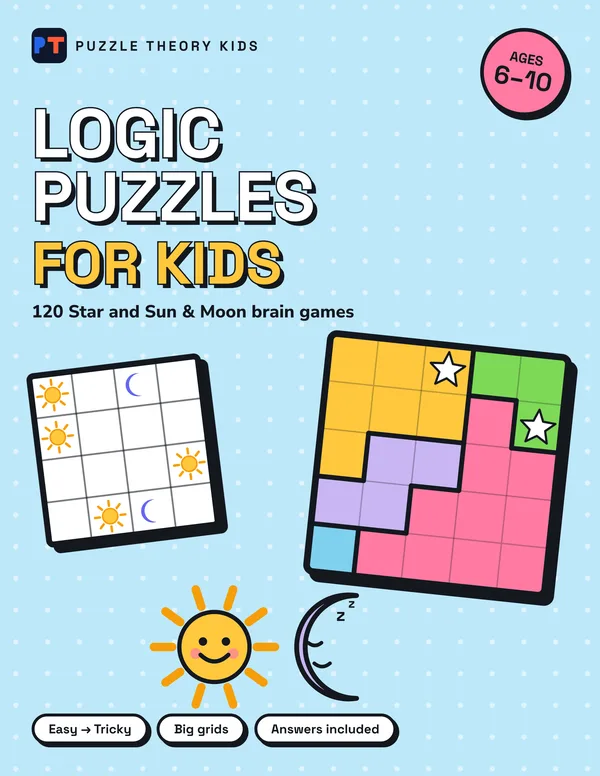
Logic Puzzles for Kids
120 Star and Sun & Moon Brain Games, Ages 6–10
Kid-sized versions of our crown and sun-and-moon puzzles, from little 4×4 grids up. Screen-free thinking for road trips, quiet time and classrooms.
- 120 puzzles in 3 levels: Easy, Medium, Tricky
- Picture rules and secret tricks
- Answers, a make-your-own page and a certificate
Get the daily puzzle by email
One short email a day with the new puzzles. No spam, unsubscribe anytime.
Where to go next
- Try it yourself in Sudoku, or jump straight to today's board.
- Browse more logic puzzles in the same family.
- Go deeper with our best daily puzzles list.
- Missed a day? Pro members can replay the last 30 daily challenges.
Frequently asked questions
Is there a free alternative to LinkedIn Patches?
Yes. Plots on Puzzle Theory uses the same idea (split the grid into rectangles, each holding one number equal to its area, with shape hints) and is free with no account, including unlimited practice.
What puzzle is Patches based on?
Patches is based on Shikaku, a classic Japanese logic puzzle where you divide a grid into rectangles so each one contains a single number equal to its area.
Can I play Patches-style puzzles without a LinkedIn account?
LinkedIn's Patches requires an account. Plots offers the same kind of puzzle with no account needed.
What do the shape icons mean?
They tell you whether a number's rectangle is a square, wider than tall, or taller than wide. Numbers without an icon can take any shape.
Is there always exactly one solution in Plots?
Yes. A solver checks every board before it's served and only accepts boards where a single layout fits all the clues.
Ready to play?
Seven free daily puzzles — word, number and logic. No signup, no ads in your way.