

LinkedIn Zip Alternative: Free Daily Path Puzzle
Love LinkedIn's Zip but want more than one board a day, or no account at all? Here's how the path-puzzle genre works and where to play Trail, a free daily version.
LinkedIn's Zip has a rule you can explain in one breath: draw a single line through every square of the grid, touching the numbered dots in order. No arithmetic, no vocabulary, nothing to memorize. You just need to look at the board and think a few moves ahead. That simplicity is exactly why it became a daily habit for so many people, and why it's frustrating when the one board of the day is gone in ninety seconds.
If you want to keep playing after today's Zip, or you'd rather not log into a professional network to solve a puzzle, this guide is for you. We'll explain how the path-puzzle genre works, what makes a good one, and where to play Trail, our free daily take on the format.
What kind of puzzle is Zip?
Zip belongs to a family that puzzle designers call path puzzles or Hamiltonian path puzzles. A Hamiltonian path is a route through a grid (or any network of points) that visits every point exactly once. Mathematicians have studied these routes since the 1800s, and finding one in a large, irregular network is famously hard for computers.
Puzzle makers turned that hard problem into a fun one by adding clues. In paper puzzle books, the best-known versions are Numbrix and Hidato, where some cells are pre-filled with numbers and you fill in the rest so consecutive numbers touch. Zip keeps the same skeleton but makes it visual: instead of writing numbers, you drag a line, and only a handful of numbered stops are shown. Walls between some cells add a second kind of clue by blocking moves.
Why one board a day isn't always enough
The daily format is a big part of the charm. Everyone gets the same board, you compare times with colleagues, and the puzzle never eats more than a few minutes. But it has downsides:
- You can't practise. If a technique clicks on Tuesday, you have to wait until Wednesday to try it again.
- You need an account. LinkedIn's games live inside the LinkedIn app and site, so you have to be signed in.
- There's no difficulty choice. Some days are easy, some are hard, and you get what you get.
None of this is a criticism of Zip itself, which is a lovely puzzle. It's just why so many players go looking for more.
Trail: our free daily path puzzle
Trail uses the same core rules. Start on the 1, draw one line through every cell of the grid, pass the numbered stops in order, finish on the highest number, and never cross a wall. Here's what you get:
- A new daily board at 00:00 UTC, the same for every player, so you can still compare with friends.
- Unlimited practice. Switch to practice mode and play as many boards as you like, each one freshly generated.
- Two sizes. Normal is a 6×6 board with nine stops. Hard (Pro) is a 7×7 board with fewer stops, so you have to plan longer stretches yourself.
- No account. Open the page and play. An account is only needed if you want your streaks saved and your times on the leaderboard.
- Mouse, touch and keyboard. Drag with a finger or the mouse, or use the arrow keys and Backspace.
Every Trail board is checked by a solver before it reaches you: the generator builds a random route through the whole grid, places the stops along it, then adds walls wherever a second route would sneak through. The board is only served once the solver confirms there is exactly one solution. You never have to guess.
Prefer paper?
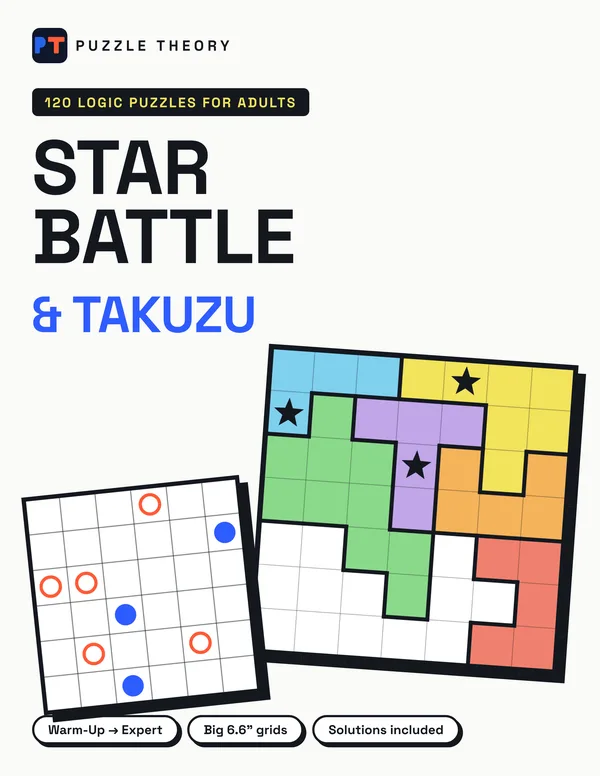
Star Battle & Takuzu
120 Logic Puzzles for Adults, Warm-Up to Expert
The paper versions of Queens and Tango: one star per row, column and region, and balanced grids of ● and ○. Big 6.6-inch grids, one puzzle per page.
- 120 puzzles, each with exactly one solution
- 3 levels: Warm-Up, Challenge, Expert
- Rules, worked examples and full solutions
How Trail compares with Zip
The two games share their rules, so the skills carry over completely. The differences are in how they're served:
- Daily board: both free. Zip needs a LinkedIn account; Trail doesn't.
- Practice: Zip offers the daily board only; Trail adds unlimited practice boards.
- Board size: Zip changes from day to day; Trail lets you choose 6×6 or 7×7.
- Extras: Trail has a built-in timer, a share card and a leaderboard.
Nothing stops you playing both. Plenty of players do Zip at work and a few Trail boards at lunch.
A quick start for new players
If you've never played a path puzzle, these three habits will get you through your first boards:
- Look at the corners first. A corner cell only has two neighbours, so unless it's the start or the end, the line must enter through one and leave through the other. Those two moves are fixed before you draw anything.
- Never cut the board in two. If your line seals off a group of empty cells, you can never reach them again. Before each move, check that every empty cell is still connected to the end of your trail.
- Count the gap between stops. If stops 4 and 5 sit two cells apart but there's a whole empty region nearby, the line has to wander through that region before it reaches 5.
We go much deeper in our Trail solving guide, including a colouring trick that settles a lot of boards on its own.
Playing for time
Once you can solve every board, the next challenge is the clock. Both Zip and Trail time your solve, and the leaderboard on Trail shows how you stack up against other players on the same daily board. A few habits make a big difference:
- Read before you draw. Spend the first five seconds scanning for corners, walls and close-together stops. A solve that starts late but never backs up is almost always faster than one that starts instantly and has to undo.
- Draw in long strokes. Once you know where a stretch of the line goes, drag through it in one movement instead of cell by cell.
- Keep your eyes ahead of your finger. While you draw one section, be planning the next. The best times come from never pausing.
- Use practice for speed, daily for pride. Run a few practice boards to warm up, then play the daily board once you're in the rhythm.
Other daily puzzles Zip players enjoy
Path puzzles train a particular kind of thinking: you reason about the whole board at once rather than one cell at a time. If that's what you like, these games scratch a similar itch:
- Queens: place one crown in every row, column and coloured region, with no two touching. Our free take on LinkedIn's Queens. More in our Queens vs LinkedIn Queens guide.
- Tango: balance suns and moons across a grid. See Tango vs LinkedIn Tango.
- Plots: split the grid into rectangles sized by their numbers, our free version of LinkedIn's Patches. Read the Patches alternative guide.
- Knot: drag points until no lines cross. A different kind of spatial puzzle, with the same satisfying final click.
Why path puzzles are good for your brain
We're careful with brain-training claims, because the science is more modest than the marketing. What path puzzles reliably give you is practice at planning ahead and holding several constraints in mind at once: where the line must go, where it can't go, and which cells it still owes a visit. They also reward patience. Rushing a path puzzle usually means backing up, and learning to slow down and check the whole board is a habit worth having. For a balanced look at the research, see our article on whether brain training games actually work.
Ready to draw?
Zip turned an old mathematical idea into one of the most pleasant minutes of the day. Trail gives you the same feeling whenever you want it: a fresh daily board, unlimited practice, no account and no guessing. Start with today's board, and if it takes you more than a couple of minutes, try a few practice rounds and watch your time drop.
Prefer paper?
Our puzzles, in a book
Star Battle & Takuzu
120 Logic Puzzles for Adults, Warm-Up to Expert
The paper versions of Queens and Tango: one star per row, column and region, and balanced grids of ● and ○. Big 6.6-inch grids, one puzzle per page.
- 120 puzzles, each with exactly one solution
- 3 levels: Warm-Up, Challenge, Expert
- Rules, worked examples and full solutions
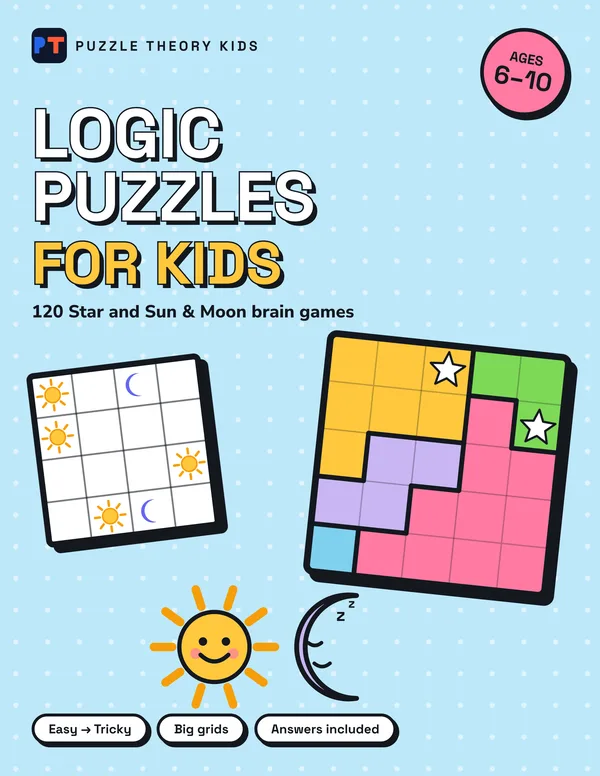
Logic Puzzles for Kids
120 Star and Sun & Moon Brain Games, Ages 6–10
Kid-sized versions of our crown and sun-and-moon puzzles, from little 4×4 grids up. Screen-free thinking for road trips, quiet time and classrooms.
- 120 puzzles in 3 levels: Easy, Medium, Tricky
- Picture rules and secret tricks
- Answers, a make-your-own page and a certificate
Get the daily puzzle by email
One short email a day with the new puzzles. No spam, unsubscribe anytime.
Where to go next
- Try it yourself in Sudoku, or jump straight to today's board.
- Browse more logic puzzles in the same family.
- Go deeper with our best daily puzzles list.
- Missed a day? Pro members can replay the last 30 daily challenges.
Frequently asked questions
Is there a free alternative to LinkedIn Zip?
Yes. Trail on Puzzle Theory uses the same rules (one line through every cell, numbered stops in order, walls you can't cross) and is free with no account, including unlimited practice boards.
Can I play Zip without a LinkedIn account?
LinkedIn's Zip requires a LinkedIn account. Trail offers the same kind of path puzzle with no account needed.
Can I play more than one Zip-style puzzle a day?
Trail has a daily board plus an unlimited practice mode, so you can play as many path puzzles as you like.
What is the puzzle type behind Zip called?
It's a Hamiltonian path puzzle: a route that visits every cell exactly once. Paper versions include Numbrix and Hidato.
Does every Trail board have exactly one solution?
Yes. A solver checks every board before it is served and adds walls until only one route fits all the clues.
Ready to play?
Seven free daily puzzles — word, number and logic. No signup, no ads in your way.