

How to Solve Zip Puzzles: 8 Path Puzzle Tips
Eight techniques for Zip-style path puzzles, from forced corners to the checkerboard parity trick. Solve LinkedIn Zip and Trail faster, without trial and error.
Path puzzles look like they're solved with your finger, but they're really solved with your eyes. The fastest players don't draw quickly; they spend the first few seconds reading the board, then draw the whole line in one smooth move. This guide teaches you what to look for. Everything here works for LinkedIn's Zip and for Trail, our free daily path puzzle, since they share the same rules.
The rules in one paragraph
Start on the 1. Draw a single line through every cell of the grid, moving up, down, left or right, never diagonally. The line must pass the numbered stops in order (1, 2, 3 and so on) and end on the highest number. It can't cross a wall and can't visit a cell twice. Every board has exactly one solution, which means that if you're careful, you never have to guess.
Tip 1: Count each cell's open neighbours
This is the foundation of everything else. A cell in the middle of the grid has four neighbours. A cell on an edge has three, and a corner has two. Each wall next to a cell removes one more.
Now think about what the line does in each cell. Apart from the start and the end, the line enters every cell once and leaves once, so it uses exactly two of that cell's open neighbours. If a cell has only two open neighbours, both connections are forced. You can draw those two short segments in your head before you touch the board.
Tip 2: Corners and walled pockets come first
Corners are the obvious case of Tip 1: two neighbours, two forced connections, as long as the corner isn't the start or the end. Walls create more of these. A wall that runs along the side of an edge cell leaves it with two exits, and a cell boxed in by two walls in the middle of the board is just as constrained.
Make a habit of sweeping the board for these cells before your first move. On many boards they lock in a third of the line before any real thinking is needed.
Tip 3: Never leave a dead end
A dead end is an empty cell that has only one open neighbour left that the line could still use to reach it. The line could enter it but never leave, so it can only be the very last cell, the one with the final number. If you spot a dead end that isn't the final stop, your current line is wrong: undo until the problem disappears.
The flip side is useful too. When you're deciding between two moves, check whether one of them would create a dead end. If it would, the other move is the right one.
Tip 4: Never split the board
If your line ever cuts the empty cells into two separate groups, one of those groups will be left unvisited, because the line can't jump. Before committing to a move along a narrow corridor, ask: "If I go this way, can I still get back to everything on the other side?"
This is the most common reason beginners get stuck at 90% complete with a little island of cells they can't reach. Good players spot the danger several moves earlier.
Tip 5: Use the gaps between stops
The numbers tell you more than the order. Compare how far apart two consecutive stops are on the board with how many cells there are to fill.
If stop 3 and stop 4 are neighbours, but there's a big empty area next to them, the line probably can't go straight from 3 to 4. Something has to fill that area, and often it's the stretch between those two stops. Conversely, a long empty stretch between two stops that are far apart can usually be drawn quite directly. Reading these gaps tells you where the line has to take a detour.
Prefer paper?
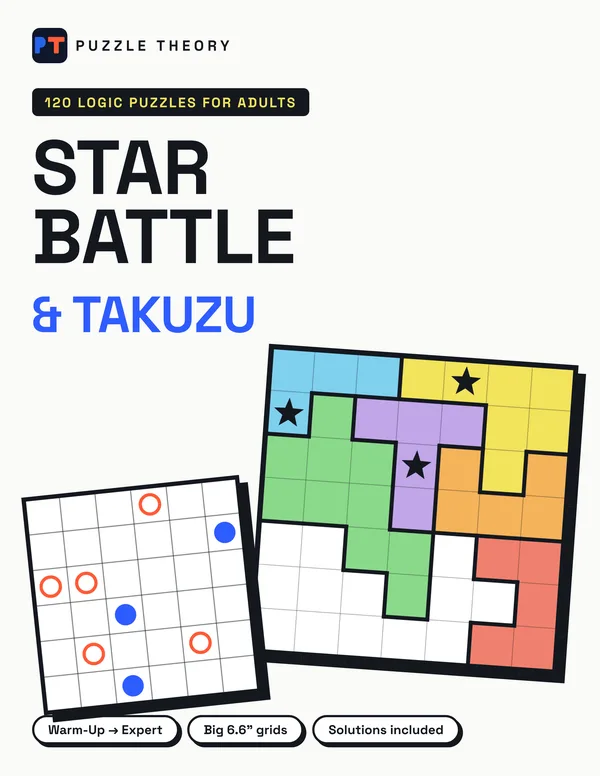
Star Battle & Takuzu
120 Logic Puzzles for Adults, Warm-Up to Expert
The paper versions of Queens and Tango: one star per row, column and region, and balanced grids of ● and ○. Big 6.6-inch grids, one puzzle per page.
- 120 puzzles, each with exactly one solution
- 3 levels: Warm-Up, Challenge, Expert
- Rules, worked examples and full solutions
Tip 6: The checkerboard parity trick
This one feels like magic the first time it works. Imagine the grid coloured like a chessboard. Every move goes from one colour to the other, so the line alternates colours: black, white, black, white.
That gives you two useful facts:
- The ends of the line. On a board with an even number of cells, such as 6×6 (36 cells), the line uses 18 of each colour, so the start and the end are on opposite colours. On an odd board such as 7×7 (49 cells), one colour has 25 cells and the other 24, so the line must start and end on the colour with 25.
- The steps between stops. If two consecutive stops are on the same colour, the number of steps between them must be even. If they're on different colours, it must be odd. When you're unsure whether a detour fits, this quickly tells you whether the count can work.
You won't need parity on every board, but on the hard ones it often breaks the deadlock.
Tip 7: Work from both ends
You don't have to draw the line in order. The start, the final stop and every numbered stop in between are fixed points, and the cells around them are often just as constrained as corners. Figure out how the line must leave stop 5 and how it must arrive at stop 6, and you've shrunk the problem from both directions.
In Trail you still draw from the 1 onwards, but you can plan any part of the route in your head first. Many good solves begin by mentally fixing the last few cells before the first drag.
Tip 8: Back up early, not late
When something feels off, undo right away. In Trail you can drag back along the line to remove steps, or tap any cell on the line to cut it back to that point. Backing up three moves costs a second; finishing a doomed line and starting over costs a minute.
A good routine when you're stuck: cut the line back to the last numbered stop, re-scan the board for forced cells (Tips 1 to 3), and try again from there.
Common mistakes to avoid
Even experienced players fall into the same traps. Watch out for these:
- Hugging the walls by habit. Running the line along the edge of the board feels safe, but it often leaves a strip of cells one row in that can no longer be reached. Check the cells beside your line, not just in front of it.
- Rushing to the next number. It's tempting to head straight for the next stop. Remember the line has to fill everything, so a direct route often strands cells that should have been visited on the way.
- Forgetting the walls are two-sided. A wall blocks movement in both directions. It's easy to remember it when you approach it, and forget it when the line comes back from the other side later.
- Ignoring the final number. The last stop must be the very last cell. If your line passes next to it with lots of the board still empty, make sure you'll be able to come back to it at the end.
A solving routine that works
Put together, here's how strong players approach a new board:
- Sweep for forced cells: corners, walled cells and anything with two open neighbours.
- Note where the line must start and end, and check parity if the board is large.
- Read the gaps between stops to find the detours.
- Draw, checking for dead ends and split regions as you go.
- If stuck, cut back to the last stop and re-scan.
Practise on paper
Path puzzles are surprisingly good on paper: you can sketch the forced corners first and draw the line in pencil. Our free printable pack has 12 Trail puzzles (six 6×6, six 7×7) with the rules and every solution.
Free printable puzzle packs
Print-ready PDFs with the rules, 10 to 12 puzzles and every answer. Tick as many packs as you like, and print as many copies as you want for home or the classroom.
Practise without waiting for tomorrow
The fastest way to get better is volume. Trail's practice mode generates a new board every time you ask, each one checked by a solver to have exactly one solution, so you can try these tips ten times in a row instead of once a day. Start with Normal (6×6, nine stops), then move to Hard (7×7, fewer stops), where Tips 5 and 6 really start to pay off.
If you're looking for a free, no-account version of Zip, our LinkedIn Zip alternative guide explains how Trail compares. And if you enjoy reasoning about grids, try Plots next, a rectangle-splitting puzzle with its own solving guide.
Prefer paper?
Our puzzles, in a book
Star Battle & Takuzu
120 Logic Puzzles for Adults, Warm-Up to Expert
The paper versions of Queens and Tango: one star per row, column and region, and balanced grids of ● and ○. Big 6.6-inch grids, one puzzle per page.
- 120 puzzles, each with exactly one solution
- 3 levels: Warm-Up, Challenge, Expert
- Rules, worked examples and full solutions
Logic Puzzles for Kids
120 Star and Sun & Moon Brain Games, Ages 6–10
Kid-sized versions of our crown and sun-and-moon puzzles, from little 4×4 grids up. Screen-free thinking for road trips, quiet time and classrooms.
- 120 puzzles in 3 levels: Easy, Medium, Tricky
- Picture rules and secret tricks
- Answers, a make-your-own page and a certificate
Get the daily puzzle by email
One short email a day with the new puzzles. No spam, unsubscribe anytime.
Where to go next
- Try it yourself in Sudoku, or jump straight to today's board.
- Browse more logic puzzles in the same family.
- Go deeper with our best daily puzzles list.
- Missed a day? Pro members can replay the last 30 daily challenges.
Frequently asked questions
What's the best way to start a Zip puzzle?
Sweep the board for cells with only two open neighbours, such as corners and cells next to walls. Unless they are the start or the end, the line must pass straight through them, which fixes several moves before you draw.
What is the checkerboard trick in path puzzles?
Colour the grid like a chessboard. The line alternates colours, so on an even-sized board the start and end are on opposite colours, and the number of steps between two stops must match their colours (even if the same colour, odd if different).
Why do I get stuck with a few cells left over?
Your line probably split the empty cells into two groups earlier on. Before each move, check that every empty cell can still be reached from the end of the line.
Do you ever have to guess in Zip or Trail?
No. Each board has exactly one solution, so every move can be worked out from the rules. When unsure, back up to the last numbered stop and look for forced cells.
Where can I practise Zip-style puzzles?
Trail on Puzzle Theory has a free daily board plus unlimited practice boards, with no account needed.
Ready to play?
Seven free daily puzzles — word, number and logic. No signup, no ads in your way.