

Logic Puzzles for Kids: Screen-Free Brain Games
The best logic puzzles for kids aged 6 to 10, what each one teaches, how to help without giving the answer, and how to make puzzle time a habit away from screens.
Children love a challenge they can win. Give a seven-year-old a puzzle that is hard but fair and you will often see something lovely: total focus, a few minutes of muttering, then a big grin when the last piece falls into place. Logic puzzles for kids are one of the simplest ways to create that moment, and they need nothing more than paper and a pencil.
This guide is for parents, grandparents and teachers. It covers which puzzles suit children aged 6 to 10, what they practise, how to help without spoiling the fun, and how to make puzzles a regular screen-free habit.
What counts as a logic puzzle for kids?
A logic puzzle is a problem you solve by thinking step by step, using clear rules, without needing to know facts. That last point matters for children. A quiz rewards whoever knows the most. A logic puzzle rewards whoever looks most carefully. A six-year-old can beat an adult at a 4×4 grid, and they know it.
Good puzzles for kids share three traits:
- Rules a child can repeat in their own words after hearing them once.
- A small start, such as a 4×4 grid, that grows as confidence grows.
- One right answer, so a child can check and feel sure they solved it.
What children practise when they solve logic puzzles
We will be careful here, because puzzle marketing often overpromises. Solving puzzles will not turn a child into a genius. What it does give them is regular practice at a set of useful habits:
- Following rules exactly. Every move must respect every rule at once.
- Reasoning step by step. "This cell can't be a star, so that one must be."
- Concentration. A puzzle asks for a few minutes of quiet attention, which is a skill in itself.
- Patience and handling mistakes. Every solver makes errors. Rubbing out and trying again, without giving up, is a lesson that reaches far beyond puzzles.
- Spatial thinking. Grid puzzles make children think about rows, columns, neighbours and shapes.
Above all, puzzles give children the experience of being stuck and then getting unstuck by their own thinking. That feeling builds real confidence.
The best logic puzzles for kids aged 6 to 10
Star puzzles (kid-sized Star Battle)
Hide one star in every row, every column and every coloured shape, and stars can never touch, not even at the corners. Children enjoy this one because it feels like a hide-and-seek game. On a 4×4 or 5×5 grid the rules are easy to check with a finger, and the "no touching" rule creates satisfying "aha!" moments. Older kids can try the full-size version as Queens, the same puzzle with crowns.
Sun and moon puzzles (kid-sized Takuzu)
Fill the grid with suns and moons so every row and column has the same number of each, and never three of the same in a row. This is a gentle introduction to patterns and counting. Kids quickly discover the two key tricks themselves: two suns side by side must have moons on both ends, and a gap between two suns must be a moon. The grown-up version is our daily Tango.
Mini Sudoku
A 4×4 Sudoku uses the numbers 1 to 4 (or four pictures for younger children). It is a classic first logic puzzle and a natural step towards the full 9×9 version on our Sudoku page.
Mazes and path puzzles
Great for the youngest solvers. They train planning ahead and spotting dead ends. For an older child who has done hundreds of mazes, a puzzle like Knot, where you untangle lines so none cross, offers the same feeling in a fresh form.
Odd one out and pattern puzzles
"Which shape doesn't belong?" and "What comes next?" puzzles are short and great for car journeys, because you can make them up out loud.
Simple logic grid stories
"Mia, Leo and Sam each have a different pet. Leo is scared of cats. Mia's pet barks..." These are perfect for ages 8 and up who enjoy reading and like the detective feel.
Try one together: a sun and moon warm-up
Here is a quick way to introduce sun and moon puzzles at the kitchen table. Draw a row of four boxes and put a sun in the first two. Ask your child: "Every row needs two suns and two moons. What goes in the last two boxes?" They will usually answer at once: two moons. You have just taught the counting rule.
Now draw a fresh row of four with a sun in the first box and a sun in the third box. Ask: "We can never have three suns in a row. What must go in the middle?" A moon, because a sun there would make three in a row. Then ask what goes in the last box. The row already has two suns, so the last box is a moon too.
Two minutes, no screen, and your child has discovered the main tricks themselves. That feeling of "I worked it out" is exactly what makes them want another puzzle. Once they are comfortable with single rows, draw a 4×4 grid, fill in four or five symbols, and let them finish it. Check together that every row and every column has two of each.
The same approach works for star puzzles: draw a 4×4 grid split into four simple shapes, explain "one star per row, column and shape, and stars can't touch", and let them try. A 4×4 star puzzle often has only a handful of possible layouts, so children can reason it out completely.
Picking the right difficulty
The best puzzle for a child is one they can solve with a bit of effort. Too easy and they get bored; too hard and they feel bad. Some signs to watch for:
- Ages 6 to 7: 4×4 grids, picture symbols instead of numbers, rules explained with an example. Expect to read the rules together.
- Ages 8 to 9: 5×5 and 6×6 grids, several puzzles in one sitting, the first "tricky" levels.
- Ages 10 and up: 6×6 and larger, puzzles with less help, and adult beginner puzzles.
Every child is different, so let your child set the pace. If they breeze through a level, move on. If they are frustrated, go back a step. Nobody needs to finish a book in order.
How to help without giving the answer
This is the hardest part for parents. When a child is stuck, it is tempting to point at the answer. Try these instead:
- Ask them to explain the rules. Often they will spot their own mistake while saying it out loud.
- Ask a narrowing question. "Which row has the fewest empty squares?" or "Can a star go here? Why not?"
- Point to an area, not a cell. "Something useful is happening in the bottom row."
- Celebrate the reasoning, not the speed. "You worked out that it couldn't be a moon. That's exactly how you solve it."
- Let them take a break. A puzzle that seemed impossible before dinner is often easy after it.
And if they find a real mistake, praise that too. Spotting your own error is a big skill.
Making puzzles a screen-free habit
Children rarely choose a puzzle over a tablet on day one. Habits help:
- Give puzzles a place. A puzzle book in the car, in the restaurant bag or on the bedside table gets used.
- Pick a regular moment. Five minutes after breakfast, on the bus, or before reading at bedtime.
- Solve together. Do a puzzle side by side with your child, or take turns. Children love to beat their parents.
- Track progress. Ticking off puzzles, or a certificate at the end of a book, gives a sense of achievement.
- Let them create. Making their own puzzle for a parent to solve is a brilliant test of whether they understand the rules.
Logic puzzles in the classroom
Teachers use logic puzzles in many ways, and they fit easily into a school day:
- Early finishers. A puzzle page is a calm, useful task for children who finish their work first, and it needs no explanation once the class knows the rules.
- Warm-ups. A small grid on the board at the start of a maths lesson gets everyone thinking about rules and patterns.
- Pair work. Two children solving one puzzle have to explain their reasoning to each other, which is great practice for talking about maths.
- Quiet time. After break or before home time, five minutes of puzzles settles a class.
- Mixed abilities. Because the rules are the same at every size, children can work on different grid sizes side by side without anyone feeling left behind.
Ask the class to write their own puzzle for a classmate. To make a good one, they have to check that it has exactly one answer, which is a surprisingly deep challenge for a ten-year-old.
Our kids' book: Logic Puzzles for Kids
We turned the two puzzles above into a paperback for children aged 6 to 10. It has 120 star and sun-and-moon puzzles made by the same generators as our daily games, scaled down for small hands. There are three levels (Easy, Medium and Tricky) starting with little 4×4 grids, picture rules and "secret tricks" so children can start alone, and all the answers at the back. At the end there is a page to make your own puzzle and a certificate to sign.
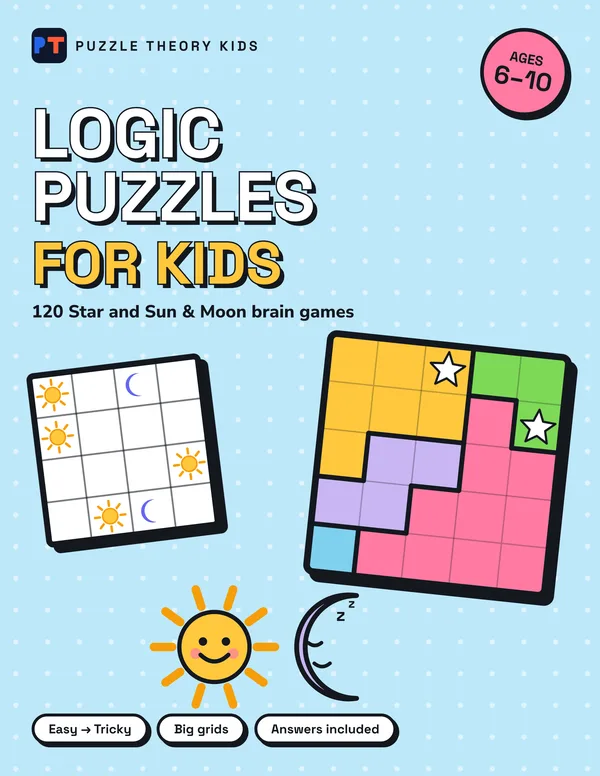
Logic Puzzles for Kids
120 Star and Sun & Moon Brain Games, Ages 6–10
Kid-sized versions of our crown and sun-and-moon puzzles, from little 4×4 grids up. Screen-free thinking for road trips, quiet time and classrooms.
- 120 puzzles in 3 levels: Easy, Medium, Tricky
- Picture rules and secret tricks
- Answers, a make-your-own page and a certificate
It is made for road trips, rainy days, quiet time and classrooms.
Older kids and grown-ups
When the kids' book is finished, the next step is real-size puzzles. Our daily games are free with no account, so older children can play Queens and Tango with a parent. For a paper challenge that suits teens and adults, Star Battle & Takuzu uses the same two puzzle types up to expert level. For more ideas on keeping the whole family's brain busy, see our guide to training your brain.
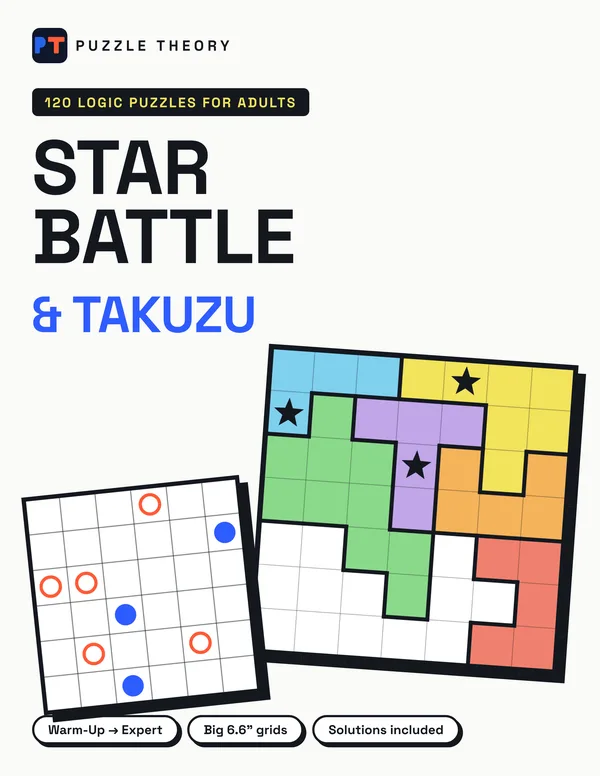
Star Battle & Takuzu
120 Logic Puzzles for Adults, Warm-Up to Expert
The paper versions of Queens and Tango: one star per row, column and region, and balanced grids of ● and ○. Big 6.6-inch grids, one puzzle per page.
- 120 puzzles, each with exactly one solution
- 3 levels: Warm-Up, Challenge, Expert
- Rules, worked examples and full solutions
Get the daily puzzle by email
One short email a day with the new puzzles. No spam, unsubscribe anytime.
Where to go next
- Try it yourself in Sudoku, or jump straight to today's board.
- Browse more logic puzzles in the same family.
- Go deeper with our best daily puzzles list.
- Missed a day? Pro members can replay the last 30 daily challenges.
Frequently asked questions
What are good logic puzzles for kids aged 6 to 8?
Small 4×4 grid puzzles work best: kid-sized Star Battle (hide one star per row, column and shape), sun and moon puzzles, mini Sudoku with pictures, mazes and odd-one-out puzzles.
What do logic puzzles teach children?
They practise following rules, step-by-step reasoning, concentration, spatial thinking and patience. Most of all, children learn to get unstuck through their own thinking.
How do I help my child with a puzzle without giving the answer?
Ask them to explain the rules, ask a question that narrows the search, point to an area rather than a cell, and praise their reasoning instead of their speed.
Are puzzle books a good screen-free activity?
Yes. A puzzle book needs no battery or signal, works in the car or a restaurant, and gives children a few minutes of focused, quiet thinking away from screens.
What age is Logic Puzzles for Kids for?
Our book is designed for children aged 6 to 10, with three levels (Easy, Medium and Tricky) that start with 4×4 grids and picture rules.
Ready to play?
Seven free daily puzzles — word, number and logic. No signup, no ads in your way.