

Logic Puzzle Books for Adults: How to Pick One
What separates a great logic puzzle book from a dull one: puzzle types, difficulty curves, grid size, unique solutions and solution pages. Plus the best picks for gifts.
Search Amazon for logic puzzle books for adults and you get thousands of results. Most of them look the same: a bright cover, a big number ("500 puzzles!") and a promise of hours of fun. Open a few and the gap in quality is huge. Some books are carefully built, with puzzles that get harder at a steady pace and always have one clean answer. Others are filler, with grids printed too small to write in, puzzles that have two answers, or no solutions at all.
This guide is about telling the two apart. We make logic puzzles for a living, both the daily games on this site and the paperbacks built from the same generators, so we know what goes wrong. Here is what to look for, which puzzle types are worth your time, and how to choose a book for yourself or as a gift.
Why solve logic puzzles on paper at all?
Daily puzzle apps are wonderful, and we would say that, since we run one. Paper still does a few things better.
A book has no notifications, no streak to protect and no tab to switch to. You can take it on a plane, to a beach or to a waiting room with no signal. Many solvers also find that they reason more carefully with a pencil. On a screen it is easy to tap, check and undo. On paper you tend to mark what you know, write small notes in the margins and commit only when you are sure. That slower rhythm is part of the pleasure.
Paper is also kinder at night. If you like a puzzle before bed, a book means no blue light and no temptation to check your email "just once" afterwards.
The logic puzzle types worth knowing
"Logic puzzle" covers a lot of ground. The best books usually focus on one or two types and do them well, so it helps to know what each one feels like.
Sudoku
The classic: fill a 9×9 grid so every row, column and 3×3 box holds the digits 1 to 9. Sudoku is the easiest type to find in print, and also the most uneven in quality. If it is your favourite, our Sudoku solving techniques for beginners will help you move up the difficulty levels.
Star Battle
Place stars in a grid divided into outlined regions so that every row, every column and every region holds exactly one star, and no two stars touch, not even diagonally. If you play Queens online, you already know Star Battle: it is the same rule set with crowns instead of stars. Star Battle is quick to learn, looks clean on the page and rewards a few elegant tricks, which we cover in our Star Battle solving guide.
Takuzu (Binairo)
Fill a grid with two symbols, usually 0 and 1 or ● and ○, so that every row and column has the same number of each and no three of the same symbol sit next to each other. It is the paper ancestor of Tango. Takuzu has a calm, almost rhythmic feel. You spend most of the time spotting pairs and gaps, and the grid fills in steady waves.
Nonograms (Griddlers, Picross)
Number clues on the edges tell you how many cells in each row and column are filled, and in what groups. Solve it and a picture appears. Nonograms are great if you like a visual reward, but they need big grids and good printing, so check the page size before you buy.
Kakuro and KenKen
Both mix arithmetic with logic. Kakuro is a crossword made of sums. KenKen asks you to fill a Latin square where caged groups must add, subtract, multiply or divide to a target. Good choices for people who like numbers more than shapes.
Logic grid puzzles
"Five people, five houses, five pets: who owns the fish?" These story puzzles are solved with a cross-reference grid. They are wordier and slower, and they suit people who like detective stories.
What makes a logic puzzle book good
Once you know which type you want, these are the things that matter.
1. Every puzzle has exactly one solution
This is the most important point and the one that cheap books most often get wrong. A real logic puzzle can be solved by deduction alone, without guessing. That is only possible if the puzzle has a single answer. If a grid has two valid solutions, at some point you will have to guess, and the "solution" page at the back will simply show one of them.
Look for a book that says its puzzles are verified for a unique solution, ideally by computer. Every puzzle in our books runs through a solver that checks there is exactly one answer before it reaches the page, the same check our daily Queens and Tango boards go through.
2. A real difficulty curve
A good book teaches you. The first puzzles should be easy enough to learn the rules on. The middle should introduce the standard techniques. The last section should make you stop and think. Books that sort puzzles into labelled levels (for example Warm-Up, Challenge and Expert) let you jump to where you are comfortable and see your progress.
Be wary of books where every puzzle is the same size and style from page 1 to page 300. That is a sign they were generated in bulk without any thought for the reader.
3. Grids big enough to write in
Logic puzzles need room for pencil marks: small dots, crosses and notes. On a pocket-sized page a 9×9 grid leaves cells the size of a fingernail. For adults, a large format such as 8.5×11 inches with one puzzle per page is much more comfortable, and it is a big plus for anyone who prefers large print.
4. Clear rules and worked examples
Even experienced solvers appreciate a short rules page with a solved example, especially for types like Star Battle or Takuzu that are less familiar than Sudoku. The best books also explain a few starting techniques, so a beginner can finish the first puzzle without help.
5. Full solutions at the back
You want to be able to check your answer, and to study a puzzle you got stuck on. Solutions should be at the back (not on the facing page, where your eye will catch them) and printed large enough to read.
6. Paper and binding
Most print-on-demand puzzle books use the same standard white paper, which takes pencil well. A matte cover feels nicer and shows fewer fingerprints. If you plan to use a pen, make sure the paper is thick enough that ink does not bleed through to the next puzzle.
How to choose by solver type
If you are new to logic puzzles, pick a book with a gentle start and good instructions. Star Battle and Takuzu are perfect first steps after Sudoku because the rules fit in two sentences.
If you love Sudoku but want something fresh, try a book of a different type with an Expert section. You will recognise the same habits (scanning, eliminating, looking for the only possible spot) used in a new way.
If you play daily puzzle apps, look for the paper version of your favourite. Queens players will feel at home with Star Battle, and Tango players with Takuzu.
If you want something to share, logic puzzles work surprisingly well as a two-person activity. One person reads the grid aloud, the other spots the next move. A book with big grids makes this easier.
Logic puzzle books as gifts
Puzzle books are one of the safest gifts there are: they suit any age, any budget and any season. A few tips:
- Match the type to the person. A crossword fan may prefer a word book such as cryptograms. A Sudoku fan will enjoy a new logic type.
- Check the difficulty. "Expert only" books can frustrate a casual solver. A book with several levels suits more people.
- Add a good pencil and an eraser. It costs almost nothing and makes the gift feel complete.
- Think about the eyes. For parents and grandparents, large grids and clear printing matter more than the puzzle count.
Buying for a child? Our kids' edition uses the same two puzzle types on small grids, with picture rules for ages 6 to 10.
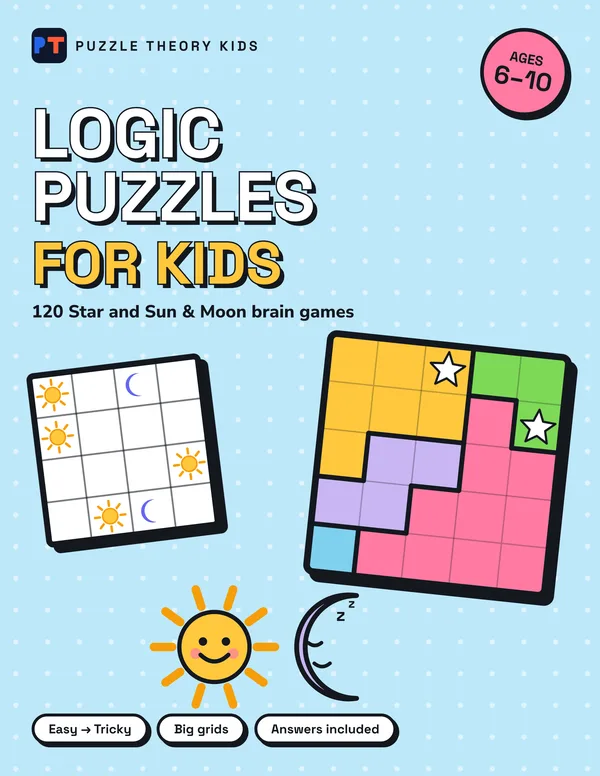
Logic Puzzles for Kids
120 Star and Sun & Moon Brain Games, Ages 6–10
Kid-sized versions of our crown and sun-and-moon puzzles, from little 4×4 grids up. Screen-free thinking for road trips, quiet time and classrooms.
- 120 puzzles in 3 levels: Easy, Medium, Tricky
- Picture rules and secret tricks
- Answers, a make-your-own page and a certificate
Pencil, pen or erasable pen?
A small but real question. Logic puzzles produce mistakes, and that is fine. A soft pencil (HB or B) with a good eraser is the classic choice, and it lets you make tiny marks for "no star here" or "must be a moon". Erasable gel pens give a darker line but can smudge on some papers. Ink is for confident solvers only, or for people who enjoy the extra pressure. Whatever you choose, keep your notes small so the grid stays readable.
Our book: Star Battle & Takuzu
We made the book we wanted to find on the shelf. It collects 120 puzzles from the generators behind our daily Queens and Tango games, sorted into three levels: Warm-Up (7×7 Star Battle and 6×6 Takuzu), Challenge (9×9 and 8×8) and Expert (the toughest 9×9 boards and 8×8 grids with no extra hints). Every grid gets its own page, with room for pencil notes.
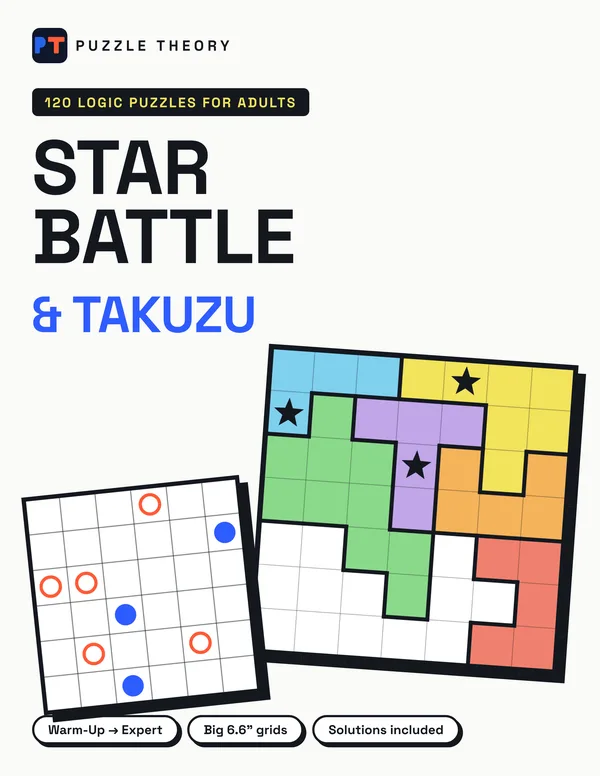
Star Battle & Takuzu
120 Logic Puzzles for Adults, Warm-Up to Expert
The paper versions of Queens and Tango: one star per row, column and region, and balanced grids of ● and ○. Big 6.6-inch grids, one puzzle per page.
- 120 puzzles, each with exactly one solution
- 3 levels: Warm-Up, Challenge, Expert
- Rules, worked examples and full solutions
If you enjoy our daily boards, it is the same feeling, without a screen.
Try before you buy
Not sure whether Star Battle or Takuzu is for you? Play them free first. Queens uses the same rules as Star Battle and Tango is our take on Takuzu with extra clues. Both have a new board every day and an unlimited practice mode, with no account needed. If you finish today's board and want more, the book will be waiting.
For more ideas, see our list of the best logic games and our guide to free online logic puzzles.
Get the daily puzzle by email
One short email a day with the new puzzles. No spam, unsubscribe anytime.
Where to go next
- Try it yourself in Sudoku, or jump straight to today's board.
- Browse more logic puzzles in the same family.
- Go deeper with our best daily puzzles list.
- Missed a day? Pro members can replay the last 30 daily challenges.
Frequently asked questions
What are the best logic puzzle types for adults?
Sudoku is the best known, but Star Battle, Takuzu (Binairo), Nonograms, Kakuro and logic grid puzzles are all great for adults. Star Battle and Takuzu are easy to learn and get genuinely hard at expert level.
How can I tell if a puzzle book is good quality?
Check that every puzzle has exactly one solution, that difficulty increases through the book, that the grids are large enough to write in, and that full solutions are printed at the back.
Is Star Battle the same as Queens?
The rules are the same: one star (or crown) per row, column and region, and no two touching, even diagonally. Queens is a digital version you can play free on Puzzle Theory.
What is a Takuzu puzzle?
Takuzu, also called Binairo or binary puzzle, asks you to fill a grid with two symbols so every row and column is balanced and no three identical symbols sit side by side.
Are logic puzzle books a good gift?
Yes. They suit any age and budget. Pick a puzzle type the person already likes, choose a book with several difficulty levels, and prefer large grids for older solvers.
Ready to play?
Seven free daily puzzles — word, number and logic. No signup, no ads in your way.