

Best Free Online Sudoku in 2026 (No Signup)
What makes a great free Sudoku site, daily vs unlimited Sudoku, and where to play online without signing up, plus tips for picking the right difficulty.
Search for "free sudoku" and you'll find thousands of sites, most of them built on the same idea: an endless stream of grids wrapped in banner ads. Some are excellent, some are frustrating, and a few serve puzzles with more than one solution. This guide explains what separates a good online Sudoku from a bad one, whether you should play a daily puzzle or an unlimited stream, and how to choose the right difficulty so you keep improving.
What makes a great online Sudoku
Every puzzle has exactly one solution
This matters more than anything else. A proper Sudoku can be solved by logic alone because only one arrangement of digits fits. Poorly generated grids sometimes have two or more solutions, which forces you to guess at some point. Good sites verify every grid with a solver before serving it.
Honest difficulty levels
"Hard" should mean the puzzle needs harder techniques, not just fewer clues. Better generators grade puzzles by the techniques required: easy grids fall to scanning and singles, medium ones need pencil marks and pairs, hard ones need pointing, box-line reductions or X-Wing. If "hard" on a site feels the same as "easy", the grading is probably based on clue count alone.
A clean, distraction-free board
You'll stare at the grid for ten minutes or more, so it should be calm: large digits, clear box borders, highlighting of the selected row, column and box, and no ads jumping between you and the puzzle. Video ads that cover the board mid-solve are the most common complaint about free Sudoku sites.
Good controls on every device
On a phone you want big tap targets and a pencil-mark toggle. On a computer you want keyboard input: arrow keys to move and number keys to enter digits. Undo is essential; automatic candidate filling is a nice extra for practising advanced techniques.
No account wall
You should be able to start a puzzle in one tap. Accounts make sense for saving streaks or competing on a leaderboard, but they shouldn't stand between you and the first grid.
Daily Sudoku vs unlimited Sudoku
There are two ways to play online, and they suit different moods.
Daily Sudoku gives everyone the same grid each day. It's a ritual: one puzzle with your morning coffee, a time to compare with friends, a streak to keep. Because there's only one, it feels like an event, and it stops you from burning an hour on grid after grid.
Unlimited Sudoku lets you play as many grids as you want. It's how you get better: when a new technique clicks, you can try it on five puzzles in a row while it's fresh. It's also perfect for a long train journey.
You don't have to choose. Many players do the daily grid for the habit and switch to unlimited practice when they want to learn. The best sites offer both, with the same quality of puzzles in each.
Prefer paper?
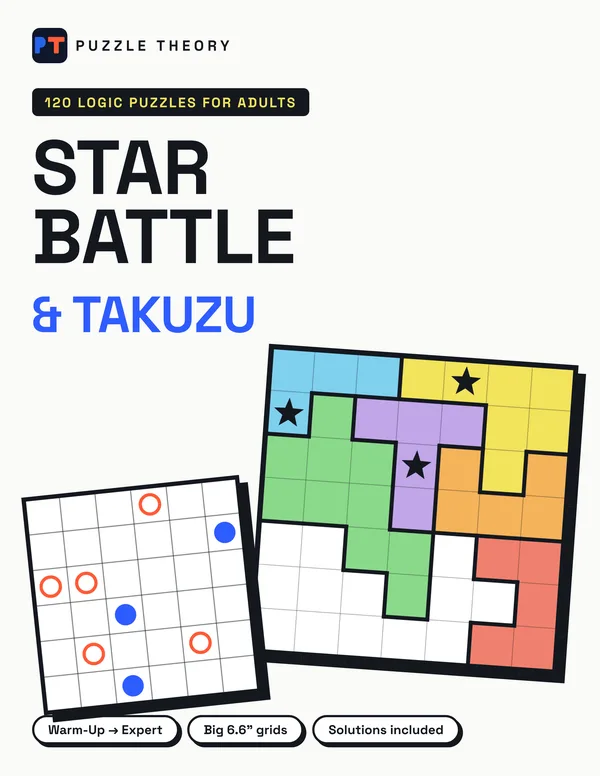
Star Battle & Takuzu
120 Logic Puzzles for Adults, Warm-Up to Expert
The paper versions of Queens and Tango: one star per row, column and region, and balanced grids of ● and ○. Big 6.6-inch grids, one puzzle per page.
- 120 puzzles, each with exactly one solution
- 3 levels: Warm-Up, Challenge, Expert
- Rules, worked examples and full solutions
Where to play free Sudoku online
Our own Sudoku covers the essentials:
- A new daily grid at 00:00 UTC, the same for everyone, plus unlimited practice boards.
- Every board is verified to have exactly one solution.
- Three levels: Easy (42 givens) is free; Medium (32) and Hard (26) are part of Pro.
- No signup to play, with an optional account for streaks and the leaderboard.
- Keyboard and touch controls (arrow keys and number keys on a computer) and a built-in timer.
- No ads between you and the board.
Other good options include the daily Sudoku in many newspapers' puzzle sections and well-known dedicated Sudoku apps. If you already subscribe to a newspaper's games bundle, its daily Sudoku is a fine habit; if not, a free site with no account does the same job.
Sudoku variants worth trying
Once classic Sudoku feels comfortable, variants keep the same core logic with a twist:
- Mini Sudoku (6×6 or 4×4): smaller grids that are perfect for beginners, children or a two-minute break.
- Killer Sudoku: no starting digits, but dotted cages whose cells must add up to a total. Great if you enjoy arithmetic.
- Jigsaw Sudoku: the 3×3 boxes are replaced by irregular shapes, which breaks your usual scanning habits.
- Samurai Sudoku: five overlapping grids that share corner boxes. A long, satisfying weekend project.
- Diagonal Sudoku: the two main diagonals must also contain 1 to 9.
Many of these work better on paper, where you can see the whole layout at once.
Online or on paper?
Online Sudoku is convenient: a new grid every day, a timer, and no eraser crumbs. Paper Sudoku has its own charms. You can make any notes you like, there are no notifications, and many people find they check their work more carefully with a pencil. A good routine is to play the daily grid online and keep a puzzle book for travel or quiet evenings.
How to pick the right difficulty
The sweet spot is a puzzle you can finish but have to think about. Some rough guides:
- New to Sudoku: start on Easy until you finish grids without pencil marks. That usually takes a week or two of daily play.
- Finishing Easy in under ten minutes: move to Medium and start using pencil marks. Learn naked pairs and pointing pairs.
- Comfortable with pairs: try Hard, and learn X-Wing.
If you get stuck for more than a few minutes on every grid, drop a level for a while. Frustration is a worse teacher than a slightly easy puzzle. Our Sudoku techniques for beginners explains every technique in the order to learn it.
What to do when you're stuck
Every Sudoku player hits a wall eventually. Before you reach for the solution, try this checklist:
- Scan every digit again, from 1 to 9. It's easy to miss a single placement after a long run of progress.
- Look at the most crowded row, column and box. The fewer empty cells, the easier the deduction.
- Write out the candidates for the cells in one box. Pairs and pointing patterns often appear as soon as they're on paper.
- Take a short break. Coming back with fresh eyes works surprisingly often.
If you're still stuck after all that, the grid is probably asking for a technique you haven't learned yet. That's the moment to read up on it, not a reason to give up.
Free printable Sudoku
If you'd like to play away from the screen, download our free printable pack: 12 Sudoku puzzles from Easy to Medium, one big grid per page, with solutions at the back.
Free printable puzzle packs
Print-ready PDFs with the rules, 10 to 12 puzzles and every answer. Tick as many packs as you like, and print as many copies as you want for home or the classroom.
Is online Sudoku good for your brain?
Sudoku is great practice for focus, careful checking and logical reasoning, and it's a pleasant way to spend ten minutes away from email. Be wary of bigger claims, though: research on brain training suggests you mostly get better at the puzzle itself rather than at memory or intelligence in general. We cover the evidence honestly in brain training games: what actually works.
Beyond Sudoku
If you love Sudoku's "only one place left" moments, try other logic puzzles built on rows, columns and regions. Queens asks for one crown per row, column and coloured region, Tango balances suns and moons, and Plots splits the grid into rectangles. Our list of the best logic puzzle games covers the classics, and if you'd like to take a break from screens, our logic puzzle books bring the same puzzles to paper.
Prefer paper?
Our puzzles, in a book
Star Battle & Takuzu
120 Logic Puzzles for Adults, Warm-Up to Expert
The paper versions of Queens and Tango: one star per row, column and region, and balanced grids of ● and ○. Big 6.6-inch grids, one puzzle per page.
- 120 puzzles, each with exactly one solution
- 3 levels: Warm-Up, Challenge, Expert
- Rules, worked examples and full solutions
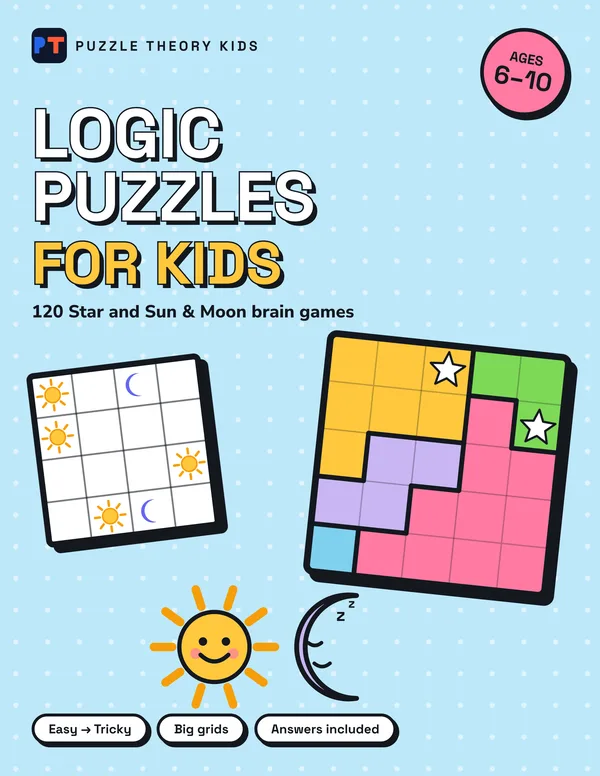
Logic Puzzles for Kids
120 Star and Sun & Moon Brain Games, Ages 6–10
Kid-sized versions of our crown and sun-and-moon puzzles, from little 4×4 grids up. Screen-free thinking for road trips, quiet time and classrooms.
- 120 puzzles in 3 levels: Easy, Medium, Tricky
- Picture rules and secret tricks
- Answers, a make-your-own page and a certificate
Get the daily puzzle by email
One short email a day with the new puzzles. No spam, unsubscribe anytime.
Where to go next
- Try it yourself in Sudoku, or jump straight to today's board.
- Browse more logic puzzles in the same family.
- Go deeper with our best daily puzzles list.
- Missed a day? Pro members can replay the last 30 daily challenges.
Frequently asked questions
Where can I play Sudoku online for free without signing up?
Puzzle Theory's Sudoku has a free daily grid and unlimited practice with no signup needed. An account is optional, only for streaks and the leaderboard.
Is daily Sudoku or unlimited Sudoku better?
Daily Sudoku is better for building a habit and comparing times with friends; unlimited Sudoku is better for practising new techniques. Many players do both.
How do I know if a Sudoku has only one solution?
You can't easily tell by looking, so choose sites that verify every grid with a solver. A well-made Sudoku never requires guessing.
What Sudoku difficulty should I start with?
Start on Easy until you can finish grids without pencil marks, then move up to Medium and learn pairs, then to Hard.
Are free online Sudoku sites full of ads?
Many are. Puzzle Theory keeps the board free of ads so nothing covers the grid while you play.
Ready to play?
Seven free daily puzzles — word, number and logic. No signup, no ads in your way.