

Binairo (Takuzu): Rules and Step-by-Step Solving Strategy
Learn Binairo and Takuzu rules with pairs, sandwiches, balance and line uniqueness, plus a complete 4×4 worked example and printable practice.
Binairo is a binary logic puzzle: fill every cell with one of two symbols, balance each row and column, avoid three identical symbols consecutively, and keep completed lines unique. Also called Takuzu, it looks simple because there are only two choices. The challenge is proving which choice belongs in each square without guessing.
This guide explains how to solve Binairo through practical patterns, a complete miniature puzzle, and a repeatable checking routine. You can work with zeros and ones, black and white circles, or any two clearly different symbols. The deductions stay the same. Start with a small board and concentrate on explaining each placement rather than finishing quickly.
Binairo rules: three constraints that work together
In standard Binairo, each row and column contains equal numbers of both symbols. A six-cell line therefore needs three zeros and three ones. No row or column may contain three consecutive identical symbols. Finally, two completed rows cannot match, and two completed columns cannot match. Rows are compared with rows, not with columns.
These are the classic rules described in this Binairo tutorial 7. Some related games add equality marks or use a different uniqueness rule, so always read the instructions on the board you are playing. A valid-looking line can still be wrong if its cells conflict with perpendicular lines.
There is no diagonal restriction. Alternating symbols are allowed, but not required: 001011 is a valid six-cell line. A pair of adjacent zeros is perfectly legal. The third consecutive zero is what breaks the rule. Distinguishing these details prevents beginners from adding imaginary constraints that make a solvable puzzle seem impossible.
Technique one: close the ends of a pair
Whenever you see two adjacent identical symbols, the cells immediately beside that pair must contain the opposite symbol. In a row containing blank, 1, 1, blank, both blanks become zero. Otherwise either side would form three consecutive ones. At an edge, only the existing neighboring cell needs to be filled.
Check the same pattern vertically. A pair near the middle of a column may unlock two cells, and each new cell can create a horizontal pair elsewhere. This makes pair checking an excellent opening move. After placing a symbol, look at its row and column before returning to a full-board scan.
Technique two: fill the sandwich
A matching pair separated by one blank also forces a move. The pattern 0, blank, 0 becomes 0, 1, 0. A zero in the middle would make three consecutive zeros. Similarly, 1, blank, 1 requires a zero between the ones. Unlike counting, this works without knowing the other cells in the line.
Do not extend the pattern to larger gaps. Two zeros separated by two blanks do not immediately fix both blanks. Likewise, matching symbols on a diagonal do not create a sandwich. The reasoning depends on exactly three consecutive cells within one row or column. Small differences in spacing change what can actually be proved.
Technique three: finish the balance
Count a line when it already contains half its cells as one symbol. In a six-cell row with three ones, every remaining blank is zero. In an eight-cell column with four zeros, the remaining cells are ones. Count placed symbols, not possibilities, and include the printed givens as well as your additions.
Balance can also expose mistakes. If a six-cell row already contains four ones, something is wrong even if there is no triple. Review your latest deductions in that row and the columns crossing it. Correcting the first unsupported placement is more useful than trying to repair the grid with additional speculative changes.
A complete four-by-four worked example
Copy this starting grid onto paper. Read each line from left to right; a dot means an empty cell. The four starting rows are 0 0 . ., 0 . . 1, . 1 . ., and . . 1 .. Standard balance, triple prevention, and line uniqueness apply throughout this example.
The first row already has both its zeros, so its two blanks become ones: 0011. The first column begins with two zeros, so the third cell becomes one. Column one now has its two zeros and must finish with another one. Its completed pattern is 0011, which is allowed even though row one matches it.
Row three now starts with two ones. Its remaining cells become zeros, producing 1100. Column three has the values 1, blank, 0, 1, so the blank becomes zero by balance. Row two now reads 0, blank, 0, 1; its sandwich requires a one, completing 0101. Column two then fixes row four's second cell as zero.
The last row is now 1, 0, 1, blank. Balance makes its final cell zero, producing 1010. The completed rows are 0011, 0101, 1100, and 1010. The columns are 0011, 0110, 1001, and 1100. Each has equal counts, no triple, and no duplicate within its own direction. Check every condition before declaring success.
Technique four: compare nearly finished lines
Uniqueness becomes useful when ordinary pair and balance checks stop producing moves. Suppose a completed row is 010101. Another row reads 0, 1, 0, 1, blank, blank. Balance demands one zero and one one in those blanks. Filling them as 0, 1 would duplicate the completed row, so their order must be 1, 0.
This deduction relies on the first four positions matching exactly. Two rows containing the same number of zeros are not duplicates; their full ordered patterns must match. Compare columns separately, and only apply this technique where standard uniqueness is part of the published rules. Some two-symbol puzzles deliberately permit repeated lines and need different reasoning.
Combining rules without guessing
Harder Binairo puzzles often require combining balance with triple prevention. Consider the six-cell row 0, blank, blank, 0, blank, blank. It needs one additional zero. Putting that zero in either of the first two blanks would force the other to one, but the full consequences also depend on the columns crossing those cells.
Instead of choosing a favorite, list the legal completions consistent with all known symbols. If every surviving completion places a one in a particular position, that one is forced. This is systematic elimination, not a lucky guess. On larger boards, restrict this comparison to the most constrained line so the list remains manageable.
A temporary assumption is another tool, provided you label it clearly and trace its consequences. If an assumed zero forces four zeros into a six-cell column, that assumption is impossible. Remove the temporary marks and place a one in the original cell. Do not treat unrelated exploratory marks as established facts during the check.
A solving routine you can repeat
Begin by scanning for adjacent pairs and sandwiches. Next count rows and columns nearing their symbol limit. Then compare almost complete lines for uniqueness. After each confirmed placement, revisit the crossing line. This short loop usually finds more useful moves than staring at one difficult corner while ignoring the rest of the board.
When progress stops, inspect the line with the fewest blanks. Ask which completions satisfy both balance and triple prevention, then compare those completions with the columns. If you are using pencil, keep speculative notes smaller than confirmed symbols. A clear distinction between certainty and possibility saves considerable time when reviewing an unexpected contradiction.
Binairo, Takuzu, and Tango: related but not identical
Binairo and Takuzu commonly describe the same classic binary-grid format. Tango also uses two symbols, equal counts, and no triples, but its equality and inequality clues matter, and you should not import classic Binairo's line-uniqueness rule automatically. Understanding the overlap lets you transfer useful techniques without accidentally changing the game's actual instructions.
If you enjoy the spatial side of deduction, try Queens next. It replaces binary filling with region placement, so the details differ while the habit remains familiar: rule out impossible positions before committing. Our Star Battle strategy guide explains that neighboring puzzle family in greater detail, including how rows and regions interact.
Practice Binairo on paper
Our adult sampler includes twelve Star Battle and Takuzu puzzles with rules and answers. It is a mixed logic pack, not twelve Binairo-only boards. Use the Takuzu pages to rehearse pairs, sandwiches, and balance. Enter your email to request the PDF; any optional book-marketing choice remains separate from requesting the download.
Free printable puzzle packs
Print-ready PDFs with the rules, 10 to 12 puzzles and every answer. Tick as many packs as you like, and print as many copies as you want for home or the classroom.
For a longer paper collection, Star Battle & Takuzu contains 120 puzzles across three levels, with worked examples and full solutions. Preview the sampler before deciding whether the format suits you. Keep the solution pages covered during practice, then compare not just the final grid but the deductions you used to reach it.
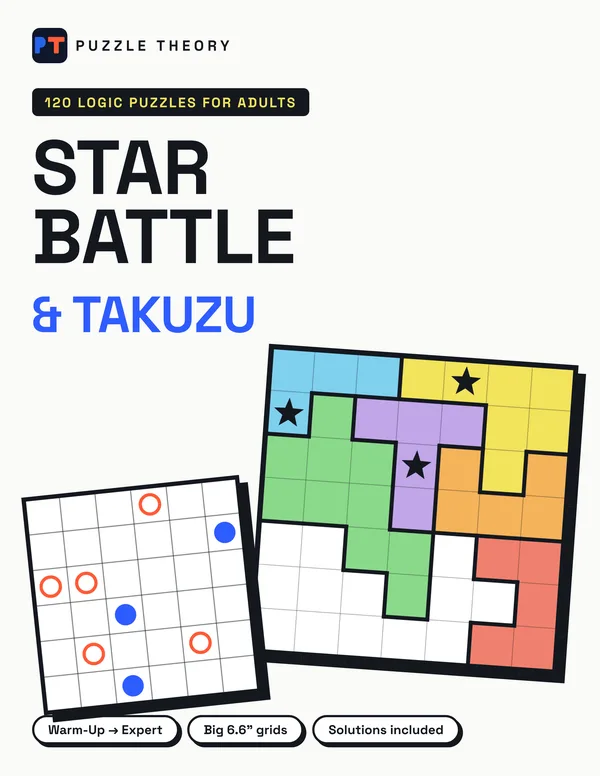
Star Battle & Takuzu
120 Logic Puzzles for Adults, Warm-Up to Expert
The paper versions of Queens and Tango: one star per row, column and region, and balanced grids of ● and ○. Big 6.6-inch grids, one puzzle per page.
- 120 puzzles, each with exactly one solution
- 3 levels: Warm-Up, Challenge, Expert
- Rules, worked examples and full solutions
Your next binary puzzle
Before increasing grid size, solve another small puzzle using the same routine. Note which rule unlocked each move, and revisit any step you cannot explain.
Choose a small board, make only moves you can explain, and check all three classic rules at the end. That simple approach builds a dependable foundation for bigger Binairo puzzles. If you want another short daily challenge after the paper session, try Tango and notice which familiar techniques still apply under its own rules.
Get the daily puzzle by email
One short email a day with the new puzzles. No spam, unsubscribe anytime.
Where to go next
- Try it yourself in Sudoku, or jump straight to today's board.
- Browse more logic puzzles in the same family.
- Go deeper with our best daily puzzles list.
- Missed a day? Pro members can replay the last 30 daily challenges.
Frequently asked questions
Are Binairo and Takuzu the same puzzle?
The names commonly refer to the same classic binary-grid puzzle: equal counts in every line, no three identical consecutive symbols, and unique completed rows and columns. Check variant instructions for extra or different rules.
What is the easiest way to start a Binairo puzzle?
Look for identical adjacent pairs and matching symbols with a single gap. Fill the opposite symbol beside the pair or inside the gap, then count the affected rows and columns.
Does Tango use every classic Binairo rule?
No. Tango shares equal symbol counts and triple prevention but uses equality and inequality clues. Do not assume classic Binairo line uniqueness unless the game instructions include it.
Ready to play?
Seven free daily puzzles — word, number and logic. No signup, no ads in your way.