

How to Solve Logic Grid Puzzles: Clues and Worked Example
Learn logic grid puzzles with an original cafe mystery, a full solution, ordering-clue tips and a repeatable method for matching categories.
Logic grid puzzles ask you to match people, objects, or events using a set of clues. You mark impossible pairings, record confirmed matches, and combine facts until every category is assigned. A well-made puzzle gives enough information to determine the answer without needing trivia, intuition, or information outside the clues.
This guide explains how to solve logic grid puzzles from the first cross to the final check. It includes a four-person puzzle, a complete reasoning walkthrough, and advice for interpreting negative and ordering clues. The aim is not merely to reveal an answer: it is to make the reasoning easy to repeat on your next board.
Understand the categories before drawing a grid
Most classic matching puzzles use categories of equal size. Four people might each have one different drink and one different arrival time. The usual setup means every drink and every time is used exactly once. Read the introduction carefully, because those one-to-one rules are what let a confirmed match eliminate other possibilities.
A two-category puzzle needs a simple square grid. Put people down the left side and drinks across the top. Each cell represents one possible pairing. With three categories, use separate grids for people versus drinks, people versus times, and drinks versus times. This lets you carry a fact from one relationship into another without relying on memory.
Write a cross for an impossible match and a tick for a confirmed match. Leave genuinely unresolved cells blank. Use your own notation if you prefer, but keep the three states distinct. Accidentally treating an unmarked cell as a confirmed possibility, or as a confirmed rejection, can undermine an otherwise sound chain of deductions.
Start with direct positive clues
A clue such as “Ben arrived at ten” immediately fixes one pairing. Tick Ben's ten o'clock cell. Because times are used once, cross out every other time for Ben and every other person for ten. One positive clue therefore generates several eliminations, making it more valuable than a single mark might suggest.
Repeat those eliminations wherever the relationship appears. If Ben's drink is known, his time also identifies that drink's arrival time in the drink-versus-time grid. This propagation is essential in larger puzzles. A fact sitting in only one small grid may already solve a cell elsewhere, but you will miss it unless you transfer the relationship.
Negative clues are useful evidence
“Ada did not order tea” gives a cross, not a replacement answer. Ada could still have any other drink consistent with the remaining clues. Avoid turning a negative statement into an unsupported positive one. The useful move is to combine several exclusions until only one legal option remains in a row or column.
Pay attention to lists. “Neither Ada nor Ben ordered cocoa” creates two exclusions. “The coffee drinker was not the first arrival” rules out a relationship between drink and time rather than directly identifying a person. Mark the category pairing the clue actually describes, then let other confirmed relationships carry it to the people grid.
Try this original cafe puzzle
Four friends, Ada, Ben, Cleo, and Dev, visit a cafe. Each orders one different drink: tea, coffee, juice, or cocoa. They arrive at different times: nine, ten, eleven, or twelve. Every drink and time is used once. Determine each person's drink and arrival time using the following five clues.
- Ben arrives at ten.
- The cocoa drinker arrives at twelve.
- Dev arrives exactly one hour after Ada.
- Cleo orders neither tea nor cocoa.
- The coffee drinker arrives exactly one hour after the juice drinker.
Draw the three four-by-four relationship grids before reading the solution. Begin with the two direct matches, then think about which consecutive arrival slots can still fit Ada and Dev. The two “exactly one hour after” clues each describe a fixed distance, not simply an unspecified later arrival. That detail drives the puzzle.
Step one: reserve the confirmed times
Ben is fixed at ten. The cocoa is fixed at twelve, although its owner is not yet known. Cross ten out for Ada, Cleo, and Dev. Next examine Ada and Dev as an ordered consecutive pair. Their possible times initially are nine and ten, ten and eleven, or eleven and twelve.
The pair cannot occupy nine and ten because Ben already occupies ten. It cannot occupy ten and eleven for the same reason. Therefore Ada arrives at eleven and Dev arrives at twelve. Since the cocoa arrives at twelve, Dev orders cocoa. The only unused arrival time is nine, which belongs to Cleo.
Step two: place the juice and coffee
The coffee drinker arrives exactly one hour after the juice drinker. Possible time pairs are nine and ten, ten and eleven, or eleven and twelve. The last pair cannot work because twelve belongs to cocoa, not coffee. Consider the first pair: it would assign juice to Cleo at nine and coffee to Ben at ten.
Now consider ten and eleven. That would assign juice to Ben and coffee to Ada, leaving tea for Cleo because Dev has cocoa. But clue four says Cleo does not order tea. This eliminates the second pair. The juice and coffee therefore occupy nine and ten, fixing Cleo's juice and Ben's coffee.
Step three: finish and verify the solution
Tea is the only remaining drink, so Ada orders tea. The complete answer is Cleo, juice, nine; Ben, coffee, ten; Ada, tea, eleven; Dev, cocoa, twelve. Read every original clue against that answer. Ben is at ten, cocoa is at twelve, Dev follows Ada by one hour, and Cleo has neither excluded drink.
Coffee follows juice by one hour as required. Each person, drink, and time appears exactly once. This final audit matters: a completed grid can look tidy while violating an overlooked clue. Checking the introduction as well as the numbered clues catches duplicate assignments and confirms that your answer satisfies the puzzle's full setup.
Translate ordering clues precisely
“Before” and “immediately before” are different constraints. Before allows any earlier position; immediately before requires neighboring positions. “Two hours after” gives a numerical gap, while “two places after” gives a position gap that may not represent two hours when the listed times are unevenly spaced. Use the category's actual values, not assumed spacing.
A person who arrives before another cannot occupy the final slot. The later person cannot occupy the first slot. Mark these boundary exclusions even before you know either exact time. Combining them with occupied slots often collapses the ordering options. In the cafe example, Ben's fixed time removed two candidate placements for the consecutive pair immediately.
Transfer relationships across grids
Suppose you know Ada has tea and Ada arrives at eleven. You can then mark tea at eleven in the drinks-versus-times grid. Conversely, if tea is at eleven and Ada has tea, Ada must arrive at eleven. This triangle of relationships is the basic bridge that makes three-category grids more powerful than separate lists.
Use the last-option rule and paired possibilities
When a row has one unresolved cell and every other cell is crossed out, that final cell must be a match. The same applies to a column. After placing the tick, complete the row and column exclusions, then transfer the fact to the other grids. A single last-option deduction can trigger several more.
What to do when your grid stalls
Revisit every clue and check whether you recorded all its consequences. Then scan nearly complete rows and columns. Look for fixed relationships that have not been transferred between category grids. Many stalls happen because information is stranded in one place, not because you need a sophisticated new technique or a speculative guess.
For harder boards, label temporary assumptions separately from confirmed marks. If a branch produces two people with the same exclusive drink, it contradicts the setup and can be rejected. Undo the entire temporary branch before recording the opposite conclusion. Our Christmas logic puzzle walkthrough offers another story-based example for practicing ordered relationships.
Paper practice and related daily puzzles
Puzzle Baron's logic-grid collection and Brainzilla provide dedicated matching puzzles. Puzzle Theory's daily Queens and Tango are different formats, but both reward systematic elimination. Do not expect their boards to use cafe-style story clues. Choose them when you want another compact deduction challenge rather than another relationship grid.
Our free adult sampler contains twelve Star Battle and Takuzu puzzles, not story-based logic grids. It includes rules and answers, making it a useful screen-free companion if you enjoy several kinds of deduction. Request the PDF below, or explore our adult printable guide before choosing which paper format suits you.
Free printable puzzle packs
Print-ready PDFs with the rules, 10 to 12 puzzles and every answer. Tick as many packs as you like, and print as many copies as you want for home or the classroom.
For your next story puzzle, cover the answer, record every exclusion, and explain the decisive clue aloud before checking your completed grid against the solution.
The Star Battle & Takuzu book expands those two formats into a 120-puzzle collection. Whether you choose a story grid or a symbol grid next, keep the same useful habit: make every mark because a rule or clue proves it, then check the finished answer against the original conditions.
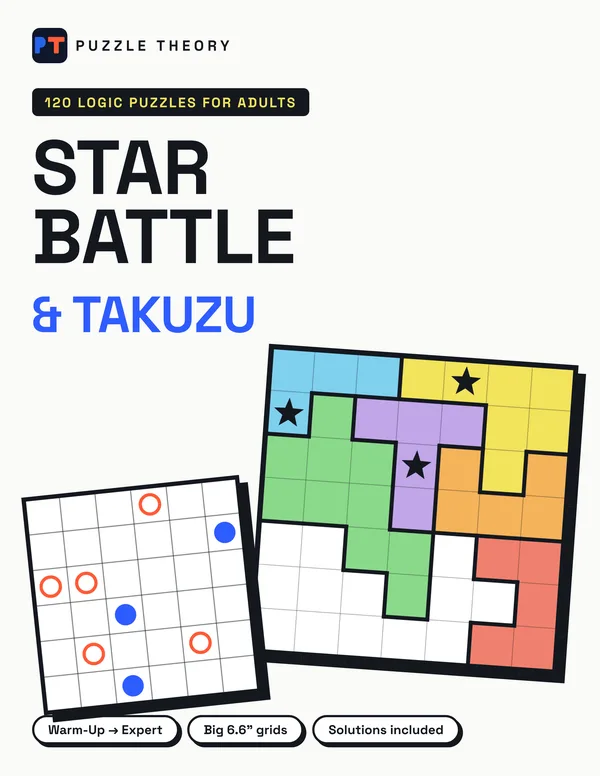
Star Battle & Takuzu
120 Logic Puzzles for Adults, Warm-Up to Expert
The paper versions of Queens and Tango: one star per row, column and region, and balanced grids of ● and ○. Big 6.6-inch grids, one puzzle per page.
- 120 puzzles, each with exactly one solution
- 3 levels: Warm-Up, Challenge, Expert
- Rules, worked examples and full solutions
Get the daily puzzle by email
One short email a day with the new puzzles. No spam, unsubscribe anytime.
Where to go next
- Try it yourself in Sudoku, or jump straight to today's board.
- Browse more logic puzzles in the same family.
- Go deeper with our best daily puzzles list.
- Missed a day? Pro members can replay the last 30 daily challenges.
Frequently asked questions
How do you start a logic grid puzzle?
Read the one-to-one category rules, draw grids for each category pairing, and enter direct positive and negative clues. A confirmed match eliminates the other cells in its row and column.
What does immediately before mean in a logic puzzle?
It means the two items occupy neighboring positions in the stated order. Before alone allows any earlier position. Numerical time gaps must follow the actual listed times.
Are the free printables story-based logic grids?
No. The adult printable sampler contains Star Battle and Takuzu symbol grids. The cafe matching puzzle and its full answer are included directly in this article.
Ready to play?
Seven free daily puzzles — word, number and logic. No signup, no ads in your way.