

Kakuro Puzzles: Rules, Combinations and a Worked Example
Solve Kakuro puzzles using distinct-digit sums, candidate intersections and subtraction. Includes useful combinations and a complete miniature example.
Kakuro puzzles are number crosswords: fill each white cell with a digit from one through nine so every horizontal and vertical run adds up to its clue. Digits cannot repeat within a run. You solve the grid by combining arithmetic with elimination, not by finding one sum that happens to fit.
If Sudoku feels familiar but you want numbers to mean something beyond symbols, Kakuro is another challenge. This guide explains clue directions, introduces useful combinations, and works through a miniature number crossword. It also shows why a correct total is not necessarily a correct answer, and how crossing runs provide the missing evidence.
Kakuro rules and grid vocabulary
A run is an uninterrupted horizontal or vertical group of white cells. Its clue gives the sum of all digits in that group. A dark cell or the grid edge ends the run. In many layouts, a diagonally divided dark cell holds an across clue in one half and a down clue in the other.
Read the directions used by your layout rather than assuming every publisher places clue numbers identically. The essential rules are consistent: digits one through nine, the correct sum in each run, and no repeated digit within that run. These are the classic rules documented by Conceptis 1.
Digits can repeat in separate runs divided by dark cells. This is different from Sudoku's whole-row restriction. Likewise, Kakuro has no standard three-by-three box rule. Each cell must satisfy its own across and down runs, but unrelated runs can use the same combination of digits.
Start with combinations, not arrangements
A two-cell run totaling three must contain one and two. Their order remains unknown. A two-cell run totaling seventeen must contain eight and nine. A three-cell run totaling six must contain one, two, and three. These combinations are forced because distinct positive digits cannot reach the required totals in any other way.
Knowing a combination is not the same as placing its members. Write small candidates in the cells until a crossing clue fixes the order. For a two-cell sum of four, the only combination is one and three, not two and two: repeated digits are forbidden. This no-repeat rule eliminates many arithmetically tempting arrangements before you inspect crossings.
Useful short-run combinations
For two cells, remember the smallest sums first: three uses 1 and 2, four uses 1 and 3, and five allows either 1 and 4 or 2 and 3. At the upper end, seventeen uses 8 and 9, sixteen uses 7 and 9, and fifteen allows 6 and 9 or 7 and 8.
For three cells, six uses 1, 2, 3; seven uses 1, 2, 4; twenty-three uses 6, 8, 9; and twenty-four uses 7, 8, 9. Memorizing these extremal combinations is helpful, but you do not need an enormous chart to begin. Generate a short list whenever a less familiar clue appears, then filter it against the crossing runs.
A miniature Kakuro example with a full solution
Draw a two-by-two block of white cells. The top row sums to three and the bottom row sums to seven. The left column sums to four and the right column sums to six. These four clues define a small number crossword; all runs have two cells, and every run forbids a repeated digit.
Call the cells A and B on the top row, then C and D beneath them. A plus B equals three, so A and B are one and two in some order. A plus C equals four, so A and C are one and three. A belongs to both sets, leaving only one as its possible value.
With A fixed at one, B becomes two to complete the top row. C becomes three to complete the left column. The bottom row needs seven, so D becomes four. Check the right column: B plus D is two plus four, which equals six. Every sum matches, and all four runs contain distinct digits.
The final block is 1 2 above 3 4. Notice that we never guessed the order of the top pair. The intersection of its allowed set with the left column's set proved the shared cell. This small example captures the central Kakuro technique even though full puzzles use larger and more varied run structures.
Intersect candidates at every crossing
Suppose an across run has two cells totaling four, so its digits are one and three. A crossing down run has two cells totaling seventeen, so its digits are eight and nine. Those candidate sets have no common digit. That is a contradiction: either a clue was read incorrectly or an earlier placement is wrong.
When sets overlap in exactly one digit, the crossing is forced. When they overlap in several digits, keep all surviving candidates. Do not choose the smaller digit merely because it looks tidier. Conceptis demonstrates this interaction throughout its worked techniques guide 4, where arithmetic combinations become precise placements through perpendicular constraints.
Subtract placed digits, then respect what remains
If a three-cell run totals sixteen and already contains a nine, the two remaining cells must sum to seven. Their arithmetic possibilities include one and six, two and five, or three and four. The nine is excluded from those cells because it is already used in the run, although the residual sum excludes it anyway here.
The same restriction matters more in longer runs. A run totaling twenty with a placed three leaves seventeen across its remaining cells, but you must still exclude three from their candidates. Treat the residual problem as a smaller sum with a reduced digit pool. Reusing a placed digit is not allowed simply because the final total would work.
Use minimum and maximum sums as bounds
Three distinct digits have a minimum sum of six and a maximum sum of twenty-four. Four distinct digits have a minimum sum of ten and a maximum sum of thirty. These bounds help reject impossible candidates. If a tentative digit leaves two empty cells needing eighteen, it cannot work: their maximum distinct sum is seventeen.
Calculate bounds with the digits actually still available. If nine is already used in the run, the largest remaining pair is eight plus seven, not nine plus eight. Crossing restrictions may lower the maximum further. Bounds do not always solve a cell, but they quickly remove choices that would leave too much or too little for the rest.
Why the number forty-five appears in Kakuro
A nine-cell run must use every digit from one through nine exactly once, so its total is forty-five. This can help with a genuinely nine-cell run or with carefully defined collections of complete runs. It does not mean every whole row, every arbitrary group of nine cells, or every square-shaped area automatically sums to forty-five.
A practical Kakuro solving sequence
Begin with short runs having only one combination. Pencil their possible digits into the cells. Intersect those possibilities with the perpendicular runs, placing any single common digit. Subtract each new placement from its two clues, then reconsider the affected runs. Follow the resulting chain before moving to another part of the board.
When nothing moves, choose a run with few remaining candidates and list its legal arrangements. Include both sum and no-repeat restrictions. Eliminate arrangements inconsistent with crossing cells. If every surviving arrangement puts the same digit in one position, that position is forced. This is a reliable progression from basic set logic to more detailed reasoning.
Mistakes that make Kakuro harder
Do not confuse a valid combination with a valid order, permit a repeated digit, or apply Sudoku's unrelated box rules. Also avoid leaving old pencil marks after a placement eliminates them. Stale candidates can make later deductions appear weaker than they really are. Update the two crossing runs whenever you confirm a cell.
If the grid contradicts itself, review the earliest unsupported choice rather than randomly changing several digits. Check clue direction, run length, and your subtraction first. Many apparent logic failures are simple transcription mistakes. Keeping a clear record of candidates makes this review faster and preserves deductions that were genuinely justified by the rules.
Where to practice Kakuro and related number games
Kakuro Conquest offers small online boards and larger challenges. Puzzle Theory does not currently have a dedicated Kakuro game, so do not expect its Sudoku board to use sum clues. Sudoku is useful adjacent practice for candidate elimination, while Target focuses on combining numbers through arithmetic operations to reach a given total.
For paper practice in another deduction format, our adult sampler includes twelve Star Battle and Takuzu puzzles with answers. It is not a Kakuro PDF. Request it if you want to alternate number crosswords with region placement and binary grids. Our number puzzle guide explains how these different styles fit together.
Free printable puzzle packs
Print-ready PDFs with the rules, 10 to 12 puzzles and every answer. Tick as many packs as you like, and print as many copies as you want for home or the classroom.
The Star Battle & Takuzu paperback provides 120 puzzles across three levels if you prefer a longer screen-free collection of those formats. Try the sampler first, keep Kakuro's combination rules distinct, and return to a small number crossword when you want another arithmetic-and-logic challenge.
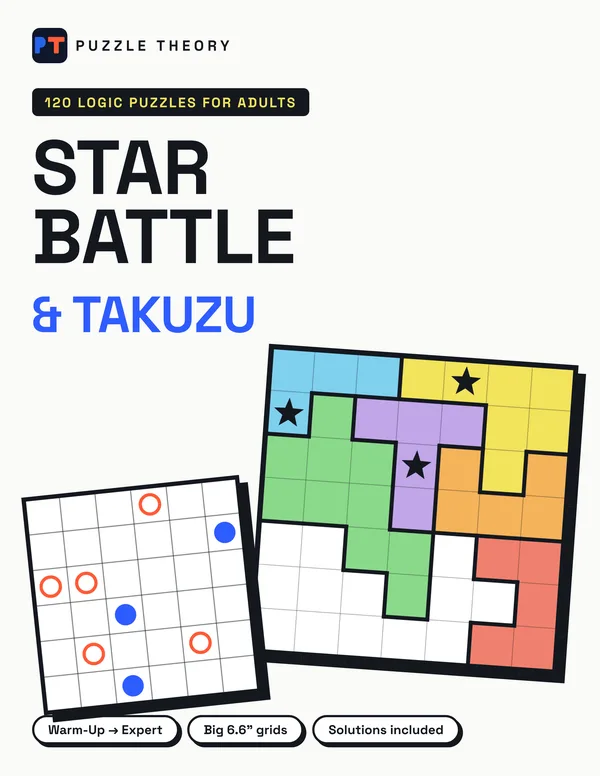
Star Battle & Takuzu
120 Logic Puzzles for Adults, Warm-Up to Expert
The paper versions of Queens and Tango: one star per row, column and region, and balanced grids of ● and ○. Big 6.6-inch grids, one puzzle per page.
- 120 puzzles, each with exactly one solution
- 3 levels: Warm-Up, Challenge, Expert
- Rules, worked examples and full solutions
Get the daily puzzle by email
One short email a day with the new puzzles. No spam, unsubscribe anytime.
Where to go next
- Try it yourself in Target, or jump straight to today's board.
- Browse more number puzzles in the same family.
- Go deeper with the Target mental-math guide.
- Missed a day? Pro members can replay the last 30 daily challenges.
Frequently asked questions
Can a digit repeat in Kakuro?
A digit cannot repeat within the same uninterrupted across or down run. It can appear again in a separate run divided by a dark cell.
What is the difference between Kakuro and Sudoku?
Kakuro uses sum clues for uninterrupted runs and forbids repeats within each run. Standard Sudoku uses rows, columns and 3×3 boxes containing digits 1–9 once, without sum clues.
Which Kakuro combinations should beginners learn first?
For two cells, three is 1+2 and seventeen is 8+9. For three cells, six is 1+2+3 and twenty-four is 7+8+9. Crossing clues determine their order.
Ready to play?
Seven free daily puzzles — word, number and logic. No signup, no ads in your way.