

How to Solve Nonograms: Overlap and Beginner Techniques
Learn how to solve nonogram puzzles with overlap, separators and line counting, including a complete 5×5 practice puzzle and common mistakes.
To solve nonograms, use the numbered clues to identify cells that must be filled and cells that must remain empty. Each clue describes consecutive filled blocks in a row or column, in order. Compare the earliest and latest legal positions of those blocks, mark any guaranteed overlap, then use crossing clues to continue.
Nonogram puzzles are also called picture logic puzzles, Griddlers, or Picross-style puzzles. Their appeal is that a picture emerges from deduction rather than drawing skill. This beginner guide teaches the rules, works through a complete five-by-five example, and explains what to check when a larger grid stops yielding obvious moves. No artistic ability is needed.
How to read nonogram clues
A row clue of 3 means one block of exactly three filled cells somewhere in that row. A clue of 2, 1 means a two-cell block followed by a one-cell block, with at least one empty cell between them. Additional empty cells may appear before, after, or between the blocks. The order cannot be reversed.
Column clues work identically, read from top to bottom. In black-and-white puzzles, every consecutive block is separated by an empty cell. Colored variants can use different separation conventions, especially between differently colored blocks. This guide covers the monochrome format; check the particular puzzle's instructions before applying its rules to a colored board.
Think of each cell as having three states: unknown, confirmed filled, and confirmed empty. A blank square is not necessarily empty. Use a cross or dot to distinguish a proved empty cell from a cell you have not solved yet. That distinction is crucial when identifying where blocks may start and end.
The overlap technique explained
Imagine a ten-cell row with a single clue of 7. The block can start as far left as cell one, covering cells one through seven. At the opposite extreme it covers cells four through ten. Both placements include cells four through seven, so those four cells are filled in every legal solution.
You have not proved whether cells one through three or eight through ten are filled. Leave them unknown. This is the heart of overlap solving: commit only to the intersection of all legal placements. A visual pattern that appears plausible is not enough. The clue must force the mark regardless of where the remaining uncertainty goes.
Count the minimum space before marking
For several clues, add the block lengths and the mandatory separating spaces. A ten-cell line with clues 3, 2, 3 needs eight filled cells and two separators: ten cells altogether. There is no spare space, so the entire line is fixed as three filled, one empty, two filled, one empty, then three filled.
Now consider clues 3, 2 in eight cells. Their minimum length is six, leaving two cells of slack. Pack both blocks as far left as possible, then as far right as possible. The first block's extreme positions overlap at cell three. The second block's positions do not overlap, so it remains unresolved until crossing information arrives.
Always compare corresponding blocks, not unrelated filled regions from the two extreme arrangements. A cell shaded in both drawings might belong to different blocks and still be empty in an intermediate arrangement. Enumerating all legal placements is the safest interpretation when a line's existing marks make the simple extreme comparison unclear.
A complete five-by-five practice puzzle
Draw a five-by-five grid. Its row clues, from top to bottom, are 1, 3, 5, 3, 1. Its column clues, from left to right, are also 1, 3, 5, 3, 1. Each number here is a separate line's single clue, not a sequence of five blocks in one line.
Start with the middle row. Its clue is five, so fill all five cells. The middle column also has clue five; fill it completely. You now have a cross through the board, including the central cell in each outer row and column. Those fixed cells are the anchors for completing the remaining lines.
The first row's only block has length one, and its middle cell is already filled. Cross out its four other cells. Do the same in the last row, first column, and last column. Each of these one-cell lines is now finished. Crossing out cells is as important as filling them because it restricts neighboring lines.
Rows two and four each need a block of three. Their outer cells are now confirmed empty, leaving exactly the three central cells available. Fill those. Columns two and four then also contain their required central three-cell blocks. The completed picture is a diamond: one, three, five, three, one filled cells in consecutive rows.
The picture helps you appreciate the result, but it did not justify any move. The row and column clues did all the work. This matters on bigger puzzles where an apparent face or symmetrical shape can tempt you to fill cells that are not actually forced. Treat recognizable imagery as a reward, not evidence.
Finish blocks and mark separators
When a block has reached its required length and you know which clue it satisfies, mark the cells immediately before and after it empty where those cells exist. Suppose a row's only clue is three and cells four through six are confirmed filled. Every other cell in that row is empty because the block is complete.
Be more careful with multiple clues. A three-cell run in a line labeled 3, 5 might be the completed first block or part of the second block. You cannot surround it with empty cells until its identity is established. Look at its distance from the edges and the space needed for the other clue.
Use edges and split lines carefully
A filled cell near an edge may force a block to extend inward. In a line whose first clue is four, a filled first cell must begin that four-cell block, so cells one through four are filled and cell five is empty. There is no room to place an earlier block before that edge cell.
An empty cell can divide a line into separate regions, but it does not automatically assign clues to those regions. Check which blocks can fit on either side. If a five-cell clue cannot fit before the divider, it must go after it. Only then solve the smaller segment using its assigned clues and available length.
What to do when a nonogram gets stuck
First recheck your crosses. Missing empty marks often hide useful deductions. Next find a row or column where confirmed cells leave little slack. List its legal block placements respecting every filled and empty cell. If all placements share a filled cell, fill it; if all avoid a cell, cross it out.
Alternate directions after each useful change. A row deduction might not solve that row immediately, yet it can force a column that feeds back into it. Keep a small list of lines affected by new marks instead of repeatedly rescanning the whole board. This makes larger puzzles more organized without relying on a particular picture.
Some nonograms require reasoning beyond isolated lines. If you explore an assumption, record it separately and stop when it produces a contradiction. Undo the temporary chain before making a confirmed mark. Do not describe every puzzle as solvable by overlap alone; that promise can mislead beginners when a legitimate harder board needs additional logic.
Common beginner mistakes
The most common error is forgetting the empty separator between blocks. Another is treating clue order as optional: 1, 4 and 4, 1 describe different arrangements. A third is counting an unknown square as empty. All three mistakes distort the line possibilities and can lead to contradictions far from the original wrong mark.
Avoid guessing from symmetry. Many images are symmetrical, but the rules do not require symmetry unless the puzzle explicitly says so. Similarly, do not count the whole line's filled total while ignoring its block lengths. Five shaded cells can satisfy clues 2, 3 only if the runs have the correct order and a separator between them.
Where to practice and what to try next
For verified rules and additional worked techniques, consult the picture-logic guides in this tutorial collection 2. Keep the current puzzle's clue list beside your work, choose a small grid, and practice explaining overlap in your own words. Understanding why a cell is forced matters more than solving a large picture quickly.
Prefer a screen-free logic session?
Our free adult sampler contains twelve Star Battle and Takuzu puzzles, with instructions and solutions. It does not contain nonograms; choose it if you want another style of pencil-and-paper deduction after learning picture logic. Request the PDF below, then work through one easy grid before trying the more challenging pages.
Free printable puzzle packs
Print-ready PDFs with the rules, 10 to 12 puzzles and every answer. Tick as many packs as you like, and print as many copies as you want for home or the classroom.
For more of those two formats, the Star Battle & Takuzu paperback collects 120 puzzles across three difficulty levels. The sampler lets you check the rules and layout before buying. If you prefer to stay online, explore today's games and use the same principle across different formats: prove a move, mark it, and revisit what changed.
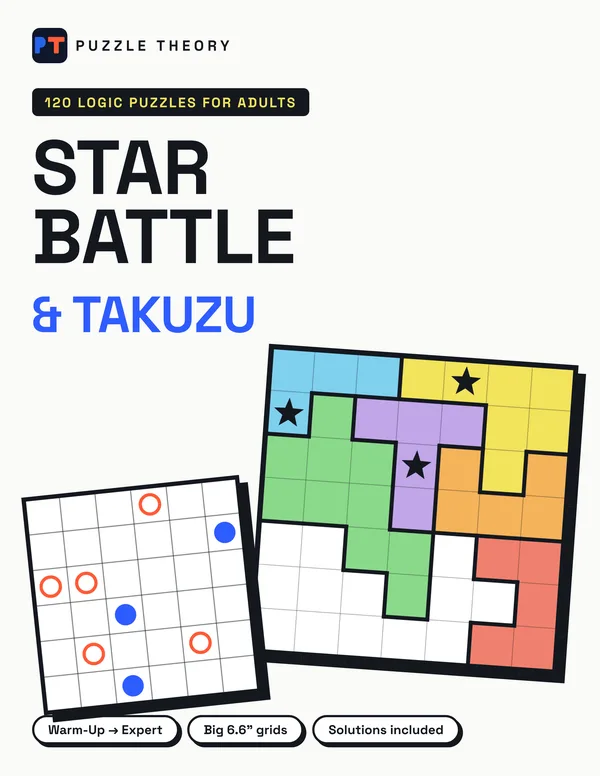
Star Battle & Takuzu
120 Logic Puzzles for Adults, Warm-Up to Expert
The paper versions of Queens and Tango: one star per row, column and region, and balanced grids of ● and ○. Big 6.6-inch grids, one puzzle per page.
- 120 puzzles, each with exactly one solution
- 3 levels: Warm-Up, Challenge, Expert
- Rules, worked examples and full solutions
Get the daily puzzle by email
One short email a day with the new puzzles. No spam, unsubscribe anytime.
Where to go next
- Try it yourself in Sudoku, or jump straight to today's board.
- Browse more logic puzzles in the same family.
- Go deeper with our best daily puzzles list.
- Missed a day? Pro members can replay the last 30 daily challenges.
Frequently asked questions
What do the numbers mean in a nonogram?
Each number gives the length of a consecutive filled block. Read row clues from left to right and column clues from top to bottom. In monochrome puzzles, leave at least one empty cell between blocks.
How does nonogram overlap work?
Compare all legal positions for a block or line. Cells filled in every possible arrangement are guaranteed filled; cells unused in every arrangement are guaranteed empty.
Do the Puzzle Theory printables contain nonograms?
No. The adult sampler contains twelve Star Battle and Takuzu puzzles with answers. It is an alternative paper logic activity, not a nonogram pack.
Ready to play?
Seven free daily puzzles — word, number and logic. No signup, no ads in your way.