

Trail — Free Daily Path Puzzle
One line, every cell, every number in order.
Trail is a free daily path puzzle: starting on the 1, draw a single line that passes through every cell of the grid exactly once and reaches the numbered stops in order, finishing on the highest number. The line moves up, down, left and right, and thick walls block some moves. It sounds simple, but the numbers and walls leave exactly one way through, so the fun is in reading the board before you commit. Free, no signup, one new board every day at 00:00 UTC, with unlimited practice in between.
Game settings
Difficulty
Unlock with ProHow to play
Rules
Start on the 1 and draw a single line that passes through every cell of the grid exactly once.
The line must reach the numbered stops in order — 1, 2, 3 and so on — and finish on the highest number.
The line moves up, down, left or right, never diagonally, and it can't cross the thick walls.
Drag from the end of your trail to extend it. Drag back to undo, or tap any cell on the trail to cut it back to there. On a keyboard, use the arrow keys and Backspace.
A new board appears every day at 00:00 UTC. Practice mode is unlimited.
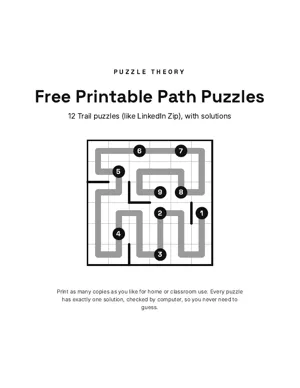 Free printable12 Trail path puzzles puzzles to print, with answers (PDF)Screen-free practice for home or the classroom.
How to play Trail
- 1Start on the cell marked 1.
- 2Drag to draw one continuous line through neighbouring cells — up, down, left or right, never diagonally.
- 3The line must visit every cell of the grid exactly once.
- 4It must pass the numbered stops in order (1, 2, 3…) and end on the highest number.
- 5Thick walls between cells can't be crossed.
- 6Drag back to undo a step, or tap a cell on your trail to cut it back to there.
- 7The daily board resets at 00:00 UTC and is the same for every player.
Trail strategy
Corners and walls decide early
A corner cell has only two neighbours, and a wall can bring an edge cell down to two as well. A cell with exactly two open neighbours must be entered from one and left through the other, so those two moves are fixed before you draw anything. Mark them in your head first.
Never leave a pocket behind
If your line cuts the board in two, the cells on the far side can never be reached again. Before each move, check that every empty cell is still connected to the end of your trail — and that you aren't sealing off the last number.
Count the gap between numbers
Two numbered stops that sit close together on the board but far apart in the count (say 3 and 4 with only a couple of cells between them) tell you the line has to wander away and fill a whole area before it comes back. Plan that detour first.
Trail vs LinkedIn Zip
Same idea — one line through every cell, numbered stops in order, walls you can't cross — with a few differences in how it's served.
| Trail | LinkedIn Zip | |
|---|---|---|
| Daily puzzle | Free, same board for everyone | Free, requires a LinkedIn account |
| Practice mode | Unlimited, free, any time | Limited to the daily puzzle |
| Timer and leaderboard | Built in | Timer only |
| Board sizes | 6×6 free, 7×7 for Pro | Varies by day |
Trail — frequently asked questions
What is Trail?
Trail is a free daily path puzzle. You draw one line that passes through every cell of the grid exactly once, reaching the numbered stops in order and finishing on the highest number, without crossing any wall.
How do you play Trail?
Press on the 1 and drag to neighbouring cells to draw your line. Drag back to undo, or tap a cell already on the line to cut it back. The puzzle is solved when the line fills the grid and has passed every number in order.
Is Trail like LinkedIn Zip?
Yes, the core rules are the same: one line through every cell, numbers in order, walls that block moves. Trail needs no account, adds unlimited free practice, and has a timer and leaderboard.
Is Trail free?
Yes, the daily board and unlimited practice mode are both free with no account required.
What's the difference between Normal and Hard mode?
Normal is a 6×6 board with nine numbered stops. Hard mode (Pro) is a 7×7 board with fewer stops, so you have to plan longer stretches of the line yourself.
Is there always exactly one solution?
Yes. Every board is checked by a solver that confirms only one line satisfies every rule before the puzzle is served.
More puzzles
Read up on this game
Comparison
LinkedIn Zip Alternative: Free Daily Path Puzzle
Love LinkedIn's Zip but want more than one board a day, or no account at all? Here's how the path-puzzle genre works and where to play Trail, a free daily version.
Strategy
How to Solve Zip Puzzles: 8 Path Puzzle Tips
Eight techniques for Zip-style path puzzles, from forced corners to the checkerboard parity trick. Solve LinkedIn Zip and Trail faster, without trial and error.
Guide
Domino Puzzle Games You Can Play Online Free
A guide to free online domino puzzle games — from classic matching to logic-based placement puzzles like Domino Regions.