

5-Minute Brain Games to Play Every Morning
Quick brain games for your morning: word, number and logic puzzles that take five minutes, how to build a morning puzzle routine, and screen-free options.
Mornings are when most of us reach for a phone, and too often that means email, news and social feeds before we're properly awake. A five-minute puzzle is a better start: short enough to fit before work, focused enough to clear your head, and finished before the coffee gets cold. Here are the best quick brain games to play each morning, grouped by type, with tips for turning them into a routine.
Why five minutes is the sweet spot
Five minutes is long enough to get absorbed in a problem and short enough to never feel like a chore. It's also the length most daily puzzles are designed for: one board, a clear goal, done. A short daily habit is far easier to keep than an ambitious one, and consistency matters more than intensity. Our article on what brain training actually does explains why regular, varied practice is the realistic way to benefit.
Word games (2–5 minutes)
- [Quintle](/games/quintle): the classic five-letter, six-guess word game. A gentle warm-up that most players finish in two or three minutes.
- [Lexicon](/games/lexicon): guess the word from counts only, with no colour clues. A real deduction puzzle for mornings when you're feeling sharp.
- [Hive](/games/hive): make as many words as you can from seven letters. Set yourself a five-minute timer and see how far you get.
- [Inkwell](/games/inkwell): a 5×5 mini crossword, perfect with breakfast.
Number games (3–5 minutes)
- [Target](/games/target): combine six numbers to hit a target exactly. One round wakes up your mental arithmetic like nothing else.
- [Equate](/games/equate): guess the hidden equation in six tries. Logic and arithmetic in one.
Logic puzzles (3–6 minutes)
Short logic puzzles are ideal in the morning because they need no vocabulary and no knowledge, just attention.
- [Queens](/games/queens): place one crown per row, column and region. Usually three to six minutes on the free board.
- [Tango](/games/tango): balance suns and moons in every row and column. Calm and satisfying.
- [Trail](/games/trail): draw one line through every cell, numbers in order. Often under two minutes once you know the tricks.
- [Plots](/games/plots): split the grid into rectangles. A quiet, visual puzzle.
- [Sudoku](/games/sudoku): the Easy board takes most players five to ten minutes.
Memory and knowledge (2–3 minutes)
- [Recall](/games/recall): watch a pattern flash on the grid and repeat it. A quick test of short-term memory.
- [Round](/games/round): five trivia questions across different subjects. Great for sharing scores.
Building a morning puzzle routine
- Anchor it to something you already do. Play while the kettle boils, with your first coffee, or on the train. Linking a new habit to an existing one is one of the most reliable ways to make it stick.
- Pick two or three games, not ten. A word game, a number game and a logic puzzle make a balanced set. Rotate if you get bored.
- Play before you check messages. Your attention is at its freshest first thing. Give it to something calm before the inbox takes over.
- Share the result. Sending your score to a friend or family group makes it social and keeps you coming back.
- Don't chase streaks at all costs. Streaks are motivating, but missing a day is fine. The habit matters more than the number.
All the games above have a free daily puzzle at 00:00 UTC, the same for everyone, with no account needed. If you finish early, every game has unlimited practice too.
A sample week
Here's one way to rotate games so the routine stays fresh:
- Monday: Quintle and Target, a gentle start to the week.
- Tuesday: Lexicon and Queens, for deduction.
- Wednesday: Hive (five minutes, then stop) and Tango.
- Thursday: Inkwell and Equate.
- Friday: Categories and Round, perfect for sharing with friends before the weekend.
- Weekend: something longer, like a Hard Sudoku, a few practice boards of Trail or Plots, or a puzzle book with breakfast.
Two games a day is plenty. Swap freely; the point is to look forward to it.
Morning puzzles with children
Children often love a breakfast puzzle, especially if a grown-up plays too. Try a quick word game where they suggest guesses, or a small logic grid they can solve with a pencil. Keep it light: one puzzle, lots of praise for good reasoning, and no pressure if it isn't finished before school.
Not a morning person?
The same routine works at any time of day. Many people prefer a puzzle at lunch as a break from work, or in the evening to wind down. If you play at night, consider paper puzzles to avoid screen glare before bed.
Why short games stick
Habits are easiest to build when the first step is tiny. A five-minute puzzle asks for almost no willpower: you don't need to block out time, set up equipment or feel motivated. That's exactly why it becomes automatic so quickly. A clear finish line helps too. Unlike an endless feed, a daily puzzle ends, which leaves you with a small sense of completion instead of the vague feeling of having scrolled too long.
Track your progress
Watching yourself improve is one of the best motivators. Note your times or number of guesses for a week, then compare with the following week. Many games, including ours, have a built-in timer and keep your stats when you're signed in. You'll often notice that puzzles which took ten minutes in your first week take five a month later, which is a lovely reminder that practice works.
Puzzles for the commute
If your morning includes a train, bus or tram ride, that's a perfect puzzle slot. A few tips: download nothing and play in the browser so you're ready in seconds; pick games that work well one-handed, like word games and Trail; and keep a slim puzzle book in your bag for days when the signal drops. A commute puzzle has a natural time limit too: you finish when you arrive, which keeps it short and stops it from turning into a long session.
A screen-free morning option
If you'd rather not start the day on a screen at all, keep a puzzle book on the kitchen table. One logic puzzle with breakfast gives you the same five minutes of focus without any notifications. Our paperback collects 120 Star Battle and Takuzu puzzles, the paper versions of Queens and Tango, sorted from warm-up to expert:
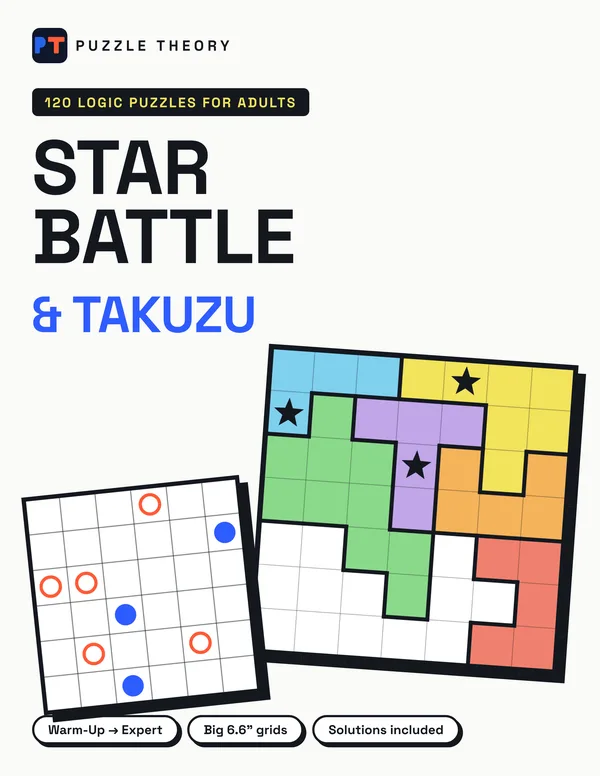
Star Battle & Takuzu
120 Logic Puzzles for Adults, Warm-Up to Expert
The paper versions of Queens and Tango: one star per row, column and region, and balanced grids of ● and ○. Big 6.6-inch grids, one puzzle per page.
- 120 puzzles, each with exactly one solution
- 3 levels: Warm-Up, Challenge, Expert
- Rules, worked examples and full solutions
For children, a puzzle at breakfast is a lovely screen-free habit too; our logic puzzles for kids guide has ideas for ages 6 to 10.
Weekend mornings
Weekends are the time to go a little longer. Swap your two quick games for one bigger puzzle: a Hard Sudoku, a few Trail or Plots boards in a row, or a page from a puzzle book over a slow breakfast. It keeps the habit alive while giving your brain a different kind of challenge from the weekday sprint.
Make it yours
The best morning brain game is the one you'll actually play tomorrow. Try a few from each group this week, keep the two or three you look forward to, and let the rest go. If you want more variety, our list of the best daily puzzle games covers the whole landscape.
Get the daily puzzle by email
One short email a day with the new puzzles. No spam, unsubscribe anytime.
Where to go next
- Try it yourself in Lexicon, or jump straight to today's board.
- Browse more brain games in the same family.
- Go deeper with what brain training actually does.
- Missed a day? Pro members can replay the last 30 daily challenges.
Frequently asked questions
What are good 5-minute brain games?
Short daily puzzles like Quintle or Hive for words, Target for numbers, and Queens, Tango or Trail for logic. Each takes around two to six minutes.
Is it good to do puzzles in the morning?
A short puzzle is a calm, focused way to start the day before email and news. It works best as a regular habit of a few minutes.
How do I build a daily puzzle habit?
Link it to something you already do, like your first coffee, pick two or three games, play before checking messages, and don't worry about missing the odd day.
Are there screen-free brain games for the morning?
Yes. A logic puzzle book gives you the same quick challenge without notifications. Puzzle Theory's Star Battle & Takuzu book has 120 puzzles from warm-up to expert.
Are these morning brain games free?
Yes. Every Puzzle Theory game has a free daily puzzle and unlimited practice, with no account needed.
Ready to play?
Seven free daily puzzles — word, number and logic. No signup, no ads in your way.