

Sudoku Swordfish Technique: A Clear Candidate Example
Understand Sudoku Swordfish with a six-cell candidate example, the elimination proof, an X-Wing comparison and checks that prevent false patterns.
A Sudoku Swordfish is a candidate-elimination pattern involving three rows and three columns. For one digit, all remaining candidates in the three selected rows must lie within the same three columns. Those rows must place the digit in different columns, so other candidates for that digit in those columns can be removed.
An example makes this concrete. The guide below explains the proof, shows the exact eliminations, and distinguishes a basic Swordfish from similar-looking patterns that do not qualify. It is designed for solvers comfortable with pencil marks who want a dependable step beyond singles, pairs, and X-Wings.
What you need to know before hunting Swordfish
Standard Sudoku requires digits one through nine once in every row, column, and three-by-three box. A candidate is a digit still possible in an empty cell under the information currently known. A Swordfish concerns one candidate digit at a time. It does not compare all the small numbers written in each cell as one group.
Keep candidates fully complete. If you overlook a legal candidate elsewhere in a selected row, you can falsely believe the digit is restricted to three columns. An invalid restriction leads to invalid eliminations. Before using any advanced pattern, recheck the selected lines against placed digits and any earlier logically justified candidate removals.
Swordfish is an elimination technique, not usually a direct placement. It may remove a digit from several cells without telling you where that digit belongs inside the pattern. Those eliminations can then expose a single or a pair. Seeing progress without immediately placing a number is normal and does not make the technique unsuccessful.
The basic Swordfish conditions
Choose one digit, such as seven. Find three rows in which all its remaining candidate positions are confined to exactly three columns. Each selected row must still need that digit, and each selected column must contain at least one of the pattern's candidates. A pattern has two or three candidates in each selected row.
For a column-based Swordfish, swap the directions: select three columns whose candidates for one digit are confined to three rows. You then eliminate from those rows outside the selected columns. The underlying rule is symmetrical. HoDoKu describes this three-base, three-cover structure in its basic fish guide 5.
A candidate example you can check
Consider digit seven with these candidate positions: row two, columns one and five; row five, columns five and eight; row eight, columns one and eight. Assume these are all the seven candidates in each of those three rows. The combined column set is one, five, and eight, so the restriction meets the basic Swordfish conditions.
The six positions form a loop rather than a filled three-by-three rectangle. Row two must place seven in column one or five. Row five must place it in column five or eight. Row eight must place it in column one or eight. Each row needs one seven, and no column can contain two sevens.
This is a candidate-pattern exercise, not a complete Sudoku board. It isolates the information needed to justify the elimination. In a real puzzle, verify the row restrictions from the actual grid before using it. Other digits in these six cells do not affect the fish directly, although they will matter when you resume ordinary solving afterward.
Why the elimination is valid
There are three required sevens, one for each selected row, and only three available columns. Column uniqueness prevents two of those sevens from occupying the same column. Therefore the three rows must use all three columns. Each selected column receives its seven somewhere within the selected rows, regardless of which particular arrangement turns out to be correct.
Any seven candidate in those columns outside rows two, five, and eight is therefore impossible. You do not need to decide between the two arrangements to make that elimination. This separation between uncertain placement and certain exclusion is what makes fish patterns powerful: multiple possible solutions to the local pattern can share the same useful consequence.
Exactly which candidates can you remove?
In the example, remove seven from columns one, five, and eight in all rows other than two, five, and eight. If seven is a candidate at row four, column five, remove it. If seven is a candidate at row nine, column eight, remove it. Only remove candidates that are actually present in those external cells.
Do not remove seven from the six pattern positions. They are precisely where the digit may still belong. Also do not remove unrelated candidates from those cells. A fish involving seven says nothing directly about whether a pattern cell contains two, four, or nine. Check each removed mark's digit and coordinates before proceeding.
Do not sweep other columns merely because they cross a selected row. The row restriction is the premise of the deduction; the selected columns outside those rows are the elimination targets. Reversing that direction is a common mistake. For a column-based fish, the directions reverse because its restricted base lines are columns instead.
Swordfish versus X-Wing
An X-Wing uses two selected rows and two selected columns for one digit. A Swordfish expands the same counting argument to three of each. In both cases, required placements are confined to an equal number of crossing lines, leaving no room for that digit outside the selected base lines within the selected cover lines.
The geometry need not look like an actual fish, and a Swordfish need not contain nine candidate cells. Our six-cell loop is valid. The important feature is that every candidate in the chosen base rows lies inside the same three columns. Focus on candidate coordinates rather than trying to recognize a decorative shape on the grid.
If two of the rows already form an X-Wing, apply that simpler deduction first and update candidates. It may reveal the same eliminations without needing a three-row explanation. Advanced names are not a ladder you must climb on every puzzle. Choose the smallest clear argument that proves the move available on your current board.
How to spot a Swordfish systematically
Pick a digit with relatively few candidates. Write down the candidate columns for each row that has two or three remaining positions. Compare combinations of three such rows. If their combined set contains exactly three columns, recheck the restrictions and inspect those columns for candidates outside the selected rows. Those external candidates are the eliminations.
For the example, the sets are {one, five}, {five, eight}, and {one, eight}. Their union has three members. By contrast, {one, five}, {five, eight}, and {one, nine} covers four columns, so it is not the basic three-column Swordfish described here. The first two rows looking promising does not rescue the extra fourth column.
If row scanning finds nothing, transpose the process. List candidate rows for columns with two or three positions. Compare three columns whose combined row set has size three. Keep the selected digit fixed throughout each search. Switching digits halfway through can accidentally create an attractive pattern that has no valid Sudoku meaning.
Beware of incomplete and finned patterns
Suppose row two also contains a seven candidate in column nine. The example's confinement premise no longer holds: a seven could escape into the fourth column. You cannot perform the basic Swordfish eliminations as though that extra candidate were absent. Either eliminate it through another valid technique first or use a separately justified advanced fish method.
Finned Swordfish patterns have additional conditions involving extra candidates and box visibility. Their eliminations are more restricted than those of a basic fish. This guide does not teach that variant, so do not reinterpret an invalid basic pattern as finned without learning the full proof. A different label does not make an unsupported elimination safe.
What to do after making the eliminations
Revisit every affected cell and line. A cell may now have a single candidate, or a column may have only one remaining location for a digit. Check pairs and box-line interactions as well. These simpler consequences are often the practical payoff of finding the Swordfish, so return to ordinary solving before hunting another advanced pattern.
Practice without turning every puzzle into a fish hunt
Review the beginner Sudoku techniques before using Swordfish. Accurate singles, pairs, and candidate maintenance make advanced patterns easier to trust. Try Puzzle Theory Sudoku for general practice, but do not assume every daily board contains a Swordfish or requires one. The technique is useful when the right candidate structure actually appears.
For a screen-free change, our adult sampler offers twelve Star Battle and Takuzu puzzles with rules and solutions. These are different formats, not Sudoku Swordfish training boards. Their elimination-based reasoning can make a pleasant companion to Sudoku sessions, especially when you want to switch away from scanning digits and practice another type of deduction.
Free printable puzzle packs
Print-ready PDFs with the rules, 10 to 12 puzzles and every answer. Tick as many packs as you like, and print as many copies as you want for home or the classroom.
Our Star Battle & Takuzu paperback expands those formats into 120 puzzles across three levels. Keep the Sudoku proof distinct: three required placements confined to three crossing lines justify eliminations outside the selected base lines. That sentence is the idea to remember whenever a possible Swordfish appears.
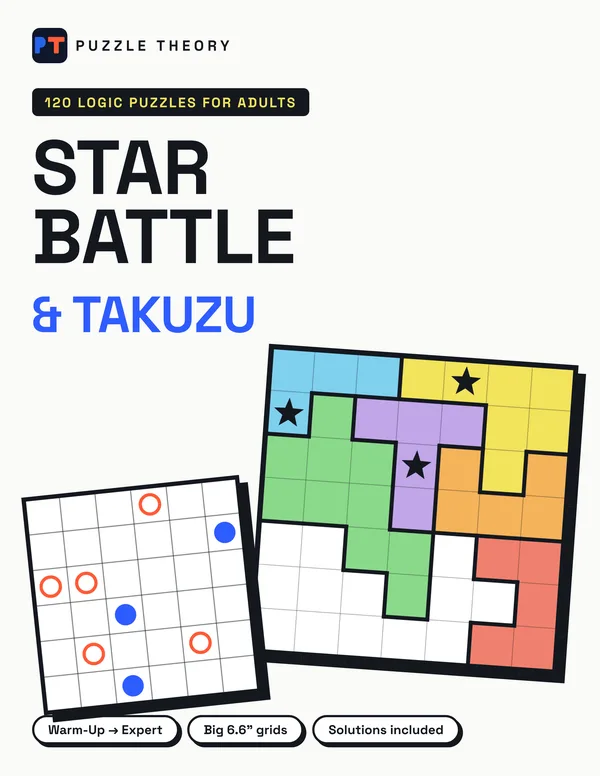
Star Battle & Takuzu
120 Logic Puzzles for Adults, Warm-Up to Expert
The paper versions of Queens and Tango: one star per row, column and region, and balanced grids of ● and ○. Big 6.6-inch grids, one puzzle per page.
- 120 puzzles, each with exactly one solution
- 3 levels: Warm-Up, Challenge, Expert
- Rules, worked examples and full solutions
Get the daily puzzle by email
One short email a day with the new puzzles. No spam, unsubscribe anytime.
Where to go next
- Try it yourself in Sudoku, or jump straight to today's board.
- Browse more logic puzzles in the same family.
- Go deeper with our best daily puzzles list.
- Missed a day? Pro members can replay the last 30 daily challenges.
Frequently asked questions
What is a basic Swordfish in Sudoku?
For one digit, three rows have all their candidates confined to three columns. Those rows must use all three columns, allowing that digit to be eliminated from the same columns outside the selected rows. The transposed column version works too.
Does a Swordfish need nine candidate cells?
No. Missing intersections are allowed. The key is that every candidate in the three selected base lines lies in the same three cover lines, with each base and cover line represented.
Can I apply a basic Swordfish if one row has a candidate in a fourth column?
No. That extra candidate breaks the three-column restriction. A finned variant needs its own additional conditions and a different elimination proof.
Ready to play?
Seven free daily puzzles — word, number and logic. No signup, no ads in your way.