

20 Best Daily Puzzle Games to Play (Free)
The best free daily puzzle games in 2026: word, number, logic, trivia and geography games with a new puzzle every day, most with no signup and no ads.
Daily puzzles have become one of the internet's nicest rituals. One small challenge, the same for everyone, arriving at the same time every day: you solve it, share your score, and get on with your life. Wordle made the format famous, but there are now dozens of excellent daily games across words, numbers, logic, trivia and geography. Here are twenty of the best, with notes on which ones are free and need no account.
What makes a great daily puzzle
- One puzzle, the same for everyone, so you can compare with friends.
- A clear end point, usually two to ten minutes.
- Fair difficulty, with a single solution you can reach by thinking.
- A shareable result that doesn't spoil the answer.
- No clutter: a clean board without pop-ups or ads in the way.
Word games
- Wordle: the original five-letter, six-guess game.
- [Quintle](/games/quintle): our five-letter game with a daily word plus unlimited practice.
- [Lexicon](/games/lexicon): Wordle without colour clues; each guess gives counts only. A real deduction puzzle in English, French or Spanish.
- [Hive](/games/hive): make words from seven letters, always using the centre one.
- [Categories](/games/categories): sixteen words, four hidden groups, four mistakes allowed.
- [ZigZag](/games/zigzag): a themed word search where words snake in any direction.
- [Weave](/games/weave): swap letters to fix six words in a grid.
- [Inkwell](/games/inkwell): a 5×5 mini crossword.
- [Cipher](/games/cipher): a daily cryptogram; decode a famous quote.
- [Loop](/games/loop): chain words around a twelve-letter box.
Number games
- [Target](/games/target): combine six numbers to hit a target exactly, like the Countdown numbers round.
- [Equate](/games/equate): guess the hidden equation in six tries.
Logic puzzles
- [Queens](/games/queens): one crown per row, column and coloured region; our free take on LinkedIn's Queens.
- [Tango](/games/tango): balance suns and moons; our take on LinkedIn's Tango.
- [Trail](/games/trail): draw one line through every cell, passing numbers in order; like LinkedIn's Zip.
- [Plots](/games/plots): split the grid into rectangles sized by their numbers; like LinkedIn's Patches.
- [Sudoku](/games/sudoku): the classic, with a fresh daily grid.
- [Domino Regions](/games/domino): place dominoes to satisfy every region's rule.
Trivia, memory and geography
- [Round](/games/round): five trivia questions a day across different subjects.
- [Atlas](/games/atlas): guess the country from distance and direction.
Honourable mentions: Recall for memory, Knot for untangling lines, and Frame for guessing films from emoji.
How to build your daily lineup
Most players settle on three to five daily games. A balanced mix might be:
- One word game (Quintle, Lexicon or Hive),
- One number game (Target),
- One logic puzzle (Queens, Tango or Trail),
- One just-for-fun game (Round or Frame) to share with friends.
That's about fifteen minutes a day. Our 5-minute brain games guide has tips for building it into your morning, and brain training games: what actually works explains what daily puzzles can and can't do for you.
How daily puzzles became a thing
Newspapers have printed a daily crossword for more than a century, and the daily Sudoku joined them in the 2000s. What changed recently is the web. Wordle showed that a single shared puzzle a day, with a spoiler-free result you could post anywhere, was more fun than an endless stream. Since then, newspapers, professional networks and independent sites have all launched their own daily games, from word grids to logic puzzles to geography quizzes. The format works because it's finite: you can't binge it, so it stays special.
Sharing without spoiling
The best daily games let you share how you did without giving the answer away: a grid of coloured squares, a time, a number of guesses or a score. When you share, avoid posting the answer itself, and give friends in other time zones a chance to play first. If you play with a group, a weekly mini-leaderboard keeps things friendly and competitive.
Daily puzzles for families and classrooms
Daily puzzles are a lovely shared activity. Families can play the same word game at breakfast and compare results at dinner. Teachers often use a quick daily puzzle as a warm-up at the start of a lesson: a five-letter word for spelling, a Target round for mental maths, or a small logic grid for reasoning. Because the puzzle is the same for everyone, the whole class can discuss strategies afterwards.
Which daily puzzles are hardest?
Difficulty depends on the person, but some daily games are known for being tough. Lexicon is harder than Wordle because it gives counts instead of coloured tiles. Hard Sudoku and the bigger boards of Queens or Tango demand real technique. Cryptograms get easier once you know common letter patterns, but the first few can be humbling. If you want a gentler start, Quintle, Round and Trail are approachable for almost everyone.
Daily puzzles in other languages
Most daily word games are English-only, but a few offer other languages. Lexicon on Puzzle Theory plays in English, French and Spanish, which makes it a fun daily practice tool if you're learning one of those languages. Logic and number puzzles, of course, need no language at all.
Keeping a streak
Streaks are motivating, but they shouldn't become stressful. A few tips: play at the same time each day, pick games short enough to fit into a busy morning, and remember that missing a day doesn't undo the benefit of all the others.
Our favourite combinations
If you'd like a ready-made lineup, try one of these:
- The quick trio (about 8 minutes): Quintle, Target and Trail.
- The thinker (about 15 minutes): Lexicon, Queens and a Medium Sudoku.
- The word lover (about 12 minutes): Hive, Inkwell and Cipher.
- The social set (about 10 minutes): Categories, Round and Frame, ideal for sharing with friends.
- The calm evening (about 10 minutes): Tango and Plots, two quiet logic puzzles.
Free, no signup, no ads in the way
All of the Puzzle Theory games above are free to play with no account. Every one has a new daily puzzle at 00:00 UTC, the same for every player, plus unlimited practice when you want more. An account is optional, for streaks and the leaderboard, and Pro adds harder levels, extra languages and replays of past daily puzzles. The board itself never has ads in the way.
Daily puzzles, offline
Some days you'd rather not look at a screen. A puzzle book gives you the same daily ritual on paper: one puzzle with your morning coffee, no notifications. Our paperback collects 120 Star Battle and Takuzu puzzles, the paper versions of Queens and Tango:
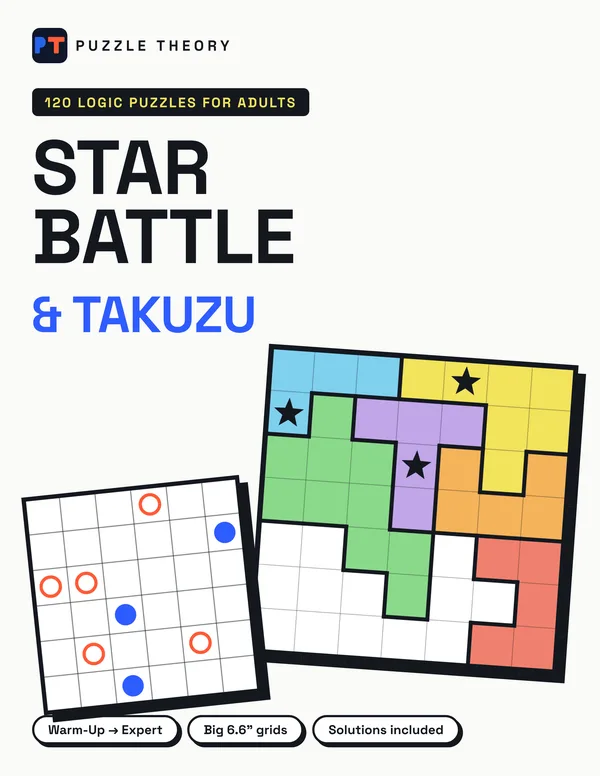
Star Battle & Takuzu
120 Logic Puzzles for Adults, Warm-Up to Expert
The paper versions of Queens and Tango: one star per row, column and region, and balanced grids of ● and ○. Big 6.6-inch grids, one puzzle per page.
- 120 puzzles, each with exactly one solution
- 3 levels: Warm-Up, Challenge, Expert
- Rules, worked examples and full solutions
Playing on your phone
All of the Puzzle Theory games run in the browser on any phone, with no app to install. Add the site to your home screen so it's one tap away each morning, and bookmark the daily page if you play on a computer, so the day's puzzles are always waiting for you. Boards are designed for touch first, with large tap targets and drag controls for the logic games.
Find your favourites
The best way to find your daily games is to try a few for a week and keep the ones you look forward to. If you love word games, our list of Wordle alternatives goes deeper; if you prefer logic, start with the best logic puzzle games.
Get the daily puzzle by email
One short email a day with the new puzzles. No spam, unsubscribe anytime.
Where to go next
- Try it yourself in Quintle, or jump straight to today's board.
- Browse more word puzzles in the same family.
- Go deeper with our word-deduction strategy guide.
- Missed a day? Pro members can replay the last 30 daily challenges.
Frequently asked questions
What are the best daily puzzle games?
Popular picks include Wordle, Quintle and Lexicon for words, Target for numbers, Queens, Tango, Trail and Sudoku for logic, and Round for trivia. A mix of types makes the best daily lineup.
Are there free daily puzzle games with no signup?
Yes. Every Puzzle Theory game has a free daily puzzle and unlimited practice with no account needed.
When do new daily puzzles come out?
On Puzzle Theory, every game gets a new daily puzzle at 00:00 UTC, the same for every player.
How many daily puzzles should I play?
Most players enjoy three to five a day, about fifteen minutes in total: a word game, a number game, a logic puzzle and something just for fun.
Can I play past daily puzzles?
Pro members can replay past daily puzzles from the in-game date picker.
Ready to play?
Seven free daily puzzles — word, number and logic. No signup, no ads in your way.